No payment now. A room preference is a request, not guaranteed availability. Personal confirmation within 24 hours.
1965 Club founded
/35 rooms and suites
/4 levels below ground
The lastbus home.
In 1965 the hardest part of a night out in Paris was not getting into the club. It was getting home. James Arch, from Asnières, went dancing in the city and found that the last public transport left before the music stopped. He organised buses to bring young suburbanites into Paris and, more importantly, to take them home afterwards. On 30 September he opened a club of his own in a faded dance hall on rue Pierre-Fontaine called L’Ange Rouge. The Bus Palladium was a solution to a transport problem with a dance floor attached.
For decades the building had more use for guitars than beds. Rock bands and then DJs kept it loud until the club closed in 2022. In April 2026 it reopened as something it had never been: a five-star hotel with thirty-five rooms above a rebuilt nightclub. Christian Casmèze, whose grandfather bought the building in 1924, had met the hotelier Nicolas Saltiel over a game of backgammon. It was an improbable beginning for an equally improbable hotel.
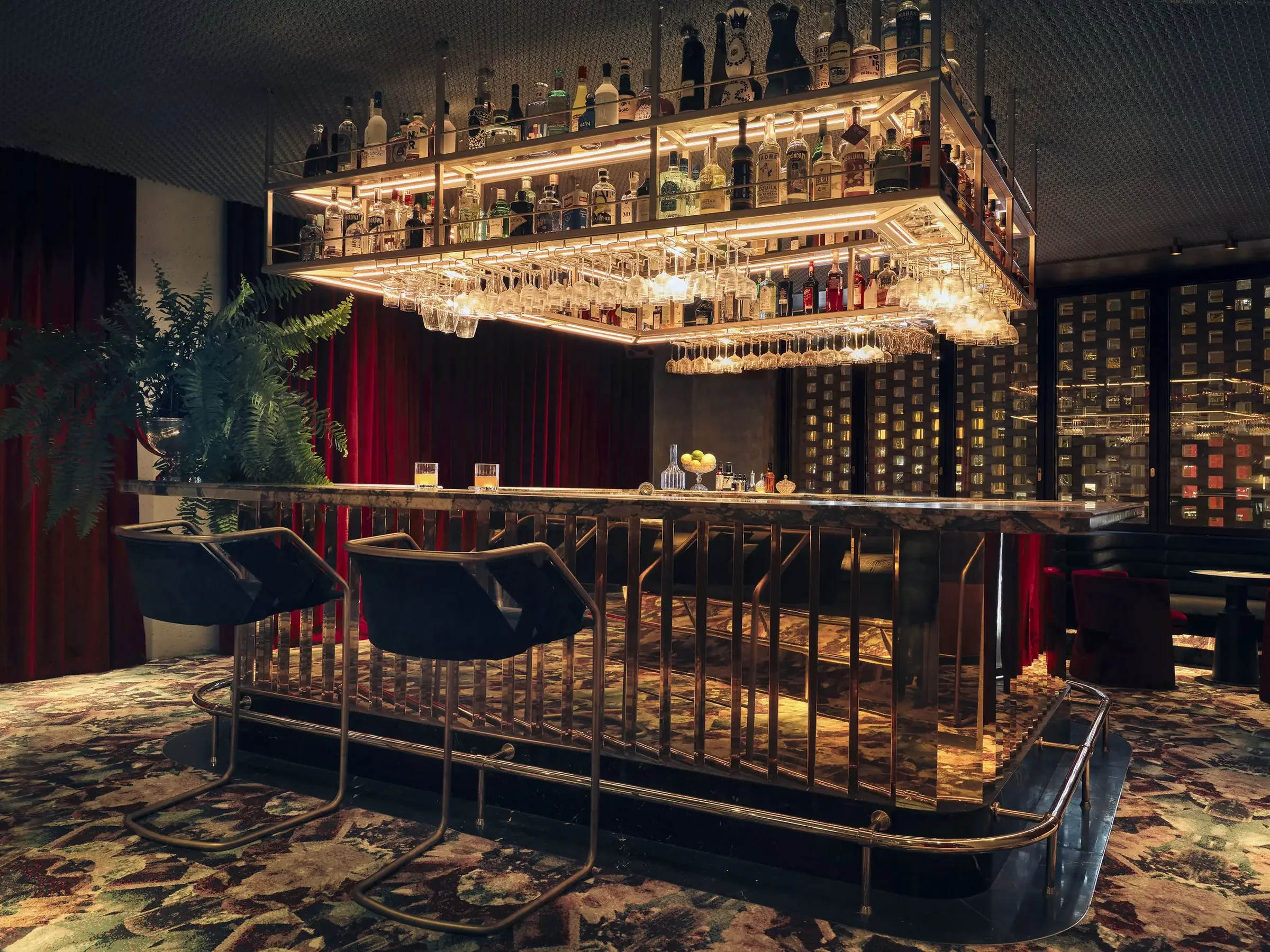
Put it the right way round: this is not a hotel that has added some nightlife. It is a night that has finally added some rooms. Rue Fontaine had been a street of café-concerts since the early 1900s. Studio KO has replaced the old two-storey building with a new one in sandblasted concrete, eight floors above ground and four below, and recreated the club underground: stage, dance floor and an enormous disco ball included.
Upstairs, the bedrooms look like the morning after a very good decade. Raw concrete ceilings, cork-clad walls and powder-pink carpet are joined by seventies furniture and wooden speakers made for listening rather than filling a shelf. The effect is warm in a slightly disreputable way, more backstage dressing room than Parisian palace. The smallest rooms are twenty-two square metres, so there is a limit to how much of the party you can take upstairs. Nor is cork a promise that the club and the bedrooms will never hear one another. Noise is an old story at this address: within six months of opening, the club had already been shut once over complaints about the noise.
Outside, Pigalle is still better at neon than bedtime. At street level a restaurant and bar keep the house sociable. That matters, because Arch conceived the Bus as an anti-private club, with buses from the suburbs for the price of a drink, in a city whose smartest clubs were built on keeping people out. A five-star hotel puts that old ambition to an awkward test: can a place built on letting people in keep its character when sleeping there has become a luxury?
The programme below ground changes and is worth checking. The neighbourhood stays lively, and the nightclub is part of the building’s identity, not an amenity to be switched off at bedtime. Silk walls and a grand spa are not the house style. The music is the point, not an inconvenience tucked out of sight. The Bus offers a more interesting bargain: the chance to sleep close to the music, without pretending it belongs to another address.
In 1965 the Bus Palladium offered a way home after the party. Sixty years on, it has found a shorter one, a few floors up. The last bus was always the moment the night ended. Here, nobody has to catch it.
Kept from the old club
The vertical red neon sign still hangs over rue Pierre-Fontaine.
The Supérieure, fully wired
The entry category is not a reduced version of the house. The Chambre Supérieure has the same raw concrete ceiling, cork-lined walls, powder-pink carpet and velvet curtains as the rooms above it, so the first key in the price list still opens the whole idea. A wooden speaker hangs in the corner of the ceiling, made for listening rather than decoration, and a curved banquette under the window turns a bedroom into a place to sit up late.
The Dalí Suite
The Dalí Suite is the house's showpiece, and it borrows its furniture from the decade the rest of the building quotes: a long, segmented sofa in orange leather curling across a circular rug in sunset colours, with mirrored panels and speakers set into the walls. It is the one suite named after an artist rather than a size or a terrace, and the place where the seventies mood fills a whole living room instead of sitting beside the bed.
A garden in a glass box
The ground floor is where the building meets the street, and where non-residents spend most of their time in it. Chef Valentin Raffali runs one kitchen from breakfast through bar plates to dinner. The room is organised around a glass cube holding a planted patio, a small piece of daylight and green at the heart of a building otherwise devoted to the night, with a wall of records shelved beside the tables.
A terrace over the zinc
Outdoor space belongs to a few named categories: the Prestige room with terrace, the junior suite with balcony and the terrace suites on the official room list. From the upper floors the view is Pigalle's roofscape rather than a monument: zinc, chimney pots and the backs of Haussmann buildings. In a house built around a club, it is the one place where daylight, rather than the stage, sets the mood.
At a glance
Where
6 rue Pierre-Fontaine, 9th arrondissement, a short walk below place Pigalle; Pigalle metro (lines 2 and 12) nearby
The house
The Bus Palladium club opened here in 1965 and closed in 2022; reopened as a hotel and club on 10 April 2026, part of the Chapitre Six collection, with building owner Christian Casmèze
Architecture
Studio KO (Karl Fournier and Olivier Marty), architecture and interiors; a new sandblasted-concrete building after demolition, four levels below ground; artistic direction by Caroline de Maigret
Rooms
35 rooms and suites: Chambre Supérieure, Chambre Deluxe, Chambre Prestige, Junior Suite Balcon, Suite Terrasse, Suite Terrasse Prestige and the Dalí Suite
Eating and drinking
Ground-floor restaurant and bar by chef Valentin Raffali, from breakfast to dinner with bar plates between services; a vinyl bar; a bar in the club
Night
Club on the first basement level, capacity about 200, with a stage; nightlife programming by Lionel Bensemoun
Why this one
01
A club in the foundations.
The stage of the 1965 Bus, rebuilt four levels down.
02
Rooms built for sound.
Cork walls, concrete ceilings and switches like amplifier knobs.
03
A restaurant on the street.
A planted glass box and a wall of records.
The Edit Notes
What a booking site will not tell you.
01
The bar moves upstairs at Prestige.
From the Chambre Prestige upwards, the official room descriptions add a bar built into the room itself; the Dalí Suite has one stocked with cassettes and books and can be hired for private events. That is the real dividing line in the price list. Below it, a room is somewhere to sleep after the club. Above it, the room is designed to keep the evening going with friends, which is what this building was always for.
02
The old walls did not survive.
The previous building could not carry the extra floors and was demolished; the architects then dug about fourteen metres down to put the club back at the bottom of the plot. Everything visible is new. What was kept is a use, not a fabric: the name, the sign, a stage, a dance floor. In a city that protects façades first, it is an unusual and rather honest order of priorities.
03
Residents are a minority downstairs.
The club holds about two hundred people; the hotel has thirty-five rooms. Even full, the house supplies a small share of the crowd, and the programming sits with a nightlife producer, Lionel Bensemoun, rather than with hotel management. That protects the club from becoming a residents' lounge with a sound system. It also means its calendar is drawn up for Paris at large, not around whoever is sleeping upstairs.
04
Glass, not a door.
In the Chambre Supérieure the bathroom sits behind fluted glass, and elsewhere a bathtub stands in a frosted-glass cube. It suits the stage-set logic of the house and lets light through a compact plan. It is less suited to two friends sharing a room, or anyone who values a solid wall between bed and basin. For that, it is worth asking at booking which layout a given room has.
The price question
Bus Palladium charges five-star rates for compact rooms, no spa and no pool. What the money buys instead is rare in Paris: a newly built house organised entirely around music, with a working club in its foundations, sound treated as part of the furniture and a restaurant that belongs to the street. Pay for the club and the address. For space, quiet evenings or a wellness programme, this is the wrong building.
What the money buys
A working club and stage four levels down, under the same roof.
Rooms designed around sound, down to the switches and door handles.
Outdoor space in the terrace suites and the Dalí Suite balcony.
What it leaves out
A spa, a pool or a gym.
Generous floor space in the entry categories.
A building of any age: everything above ground is new.
Who it suits
Book it to be close to live music in Pigalle, in a Chambre Prestige or above if the evening is meant to continue in the room. Look elsewhere for a hushed house, a large room or a spa.
Who should spend elsewhere
Maison Souquet
On rue de Bruxelles in the 9th: twenty rooms in a former maison close, with a small indoor pool that can be reserved privately.
Le Pigalle
A smaller design hotel in the same neighbourhood, where every room has a sound system and its own music selection.
The Extra Edit
Confirmed with your quote
YOUR EXTRA
Something extra, from us.
Ask for a stay and a person takes it from there. Any hotel privileges that apply, and a personal Extra arranged by us, are confirmed with your bookable quote.
SipDrinks
SavourCulinary
DiscoverExperience
Tell us which Extra appeals in your request. Nothing is charged when you ask, and no upgrade is promised.
8.0
Excellent.
The Edit score, out of 10: a provisional grade, which may still change.
The Edit score is the editor's grade for the level of the hotel, out of ten. It weighs what the outside judges say (Michelin Keys, Forbes Travel Guide, World's 50 Best Hotels, Atout France palace status, La Liste), what changed in the last two years and what guests write now; where these and the editor's own judgement disagree, the editor decides. A spa with a pool worth booking for adds up to two tenths.
Why book through The Edit
Our personal Extra
A drink, a meal or an experience: chosen by you, arranged by us.