No payment now. A room preference is a request, not guaranteed availability. Personal confirmation within 24 hours.
1342 first written record of the fortress
/300 acres of private forest
/1998 the chef's first year in the kitchen
A billetfor the Louvre.
Lot, France44°51′ N 1°32′ E
In the last years of the Second World War, more than eighty crates from the Louvre sat out the danger at the Château de la Treyne, above the Dordogne. The star among them was the Seated Scribe, a cross-legged Egyptian figure some four and a half thousand years old, his papyrus open on his knees as if about to take notes. In the end the notes were taken by his keeper, the museum's archivist Lucie Mazauric, who wrote in her memoirs that the château was not very beautiful. It is hard to think of a review that has dated worse.
She might not recognise it now. The house stands white and spruce on the edge of its cliff, its square tower so close to the river that it seems to float, with a French garden laid out in front and a Lebanon cedar that has been spreading its arms for some three centuries. Michèle Gombert bought the place in the eighties, and her son Philippe and his wife, Stéphanie, have long run it as an eighteen-room hotel with the manners of a family home.
The rooms are where the house has the most fun with its past. The old chapel is now a bedroom, painted vault and stained glass intact, which makes it one of the few places where a lie-in feels faintly sacrilegious. On the second floor, a room named Scribe keeps a little gouache of the old statue hanging in the bathroom, a fairly modest billet for someone used to the Louvre.
Days drift towards the water. A shuttle runs guests to the canoe base for a paddle down the Dordogne, with a picnic from the kitchen stowed in the bow, while the less nautical stay with the heated pool and its little beach of local pebbles. Neither option involves much hurry.
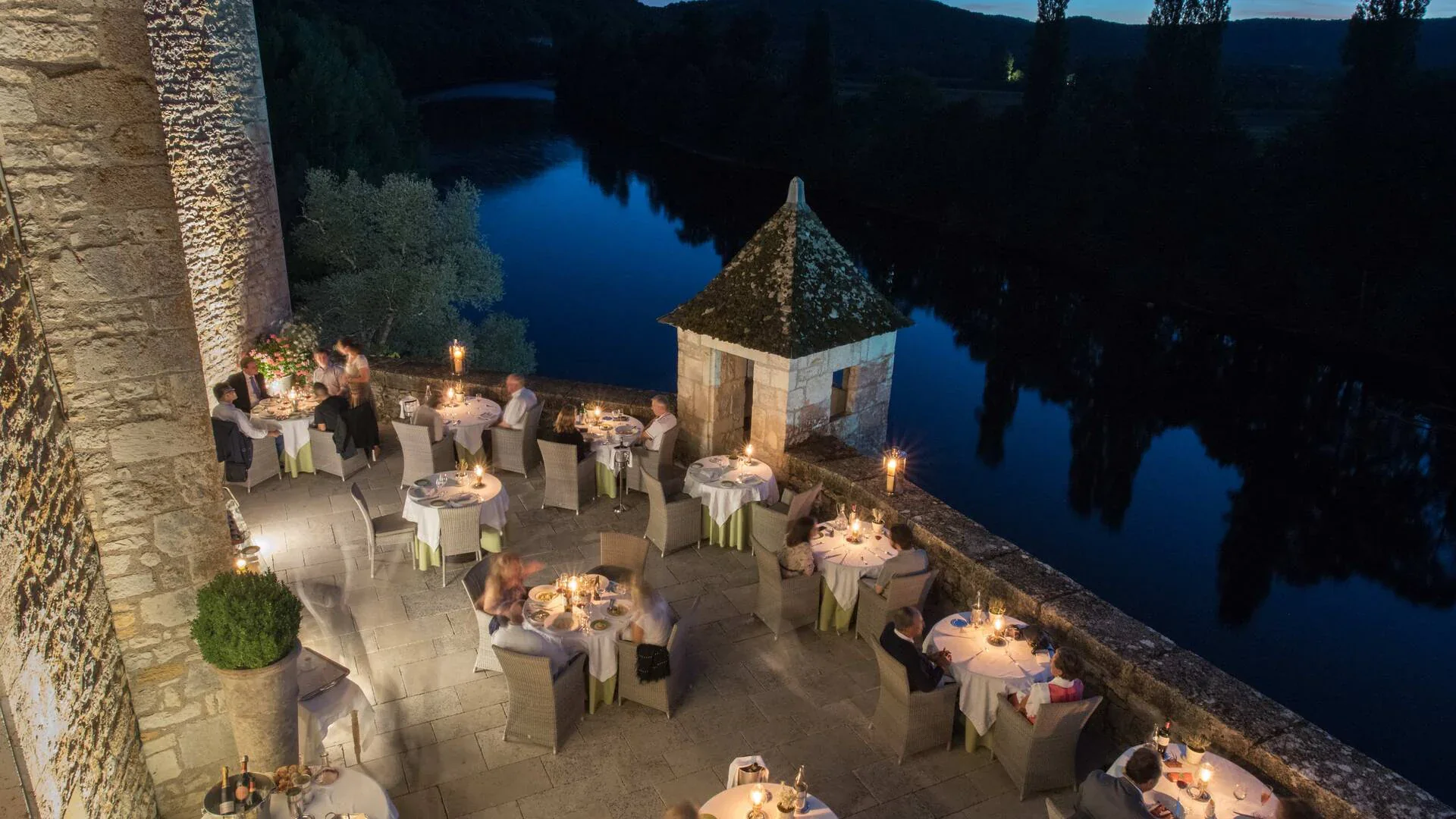
In summer, dinner moves onto the terrace, candlelit, with the river sliding past in the dark below. When the nights cool, the tables return to the Louis XIII salon, two storeys high, around a carved fireplace of heroic proportions. Stéphane Andrieux cooks the region without fuss, from foie gras to lamb raised on the limestone plateaux of the Quercy, and he has been at it for close to thirty years, which makes him a far longer-standing resident than the Seated Scribe.
Mazauric shared the house with her husband, a curator at the museum, and their teenage daughter, and families still fit in well, above all in the tower suite known as the Golden Prison, a cell that sleeps five in comfort. Couples and anyone with a soft spot for history will feel most at home. Some rooms lean towards the old-fashioned, which is part of the charm or not, depending on taste. Rocamadour and the caves of the valley are within easy reach by car, which is essential here, and the château shuts from mid-November until late March.
Lucie Mazauric thought the château not very beautiful. In fairness, she was busy saving the Louvre.
On record
In November 1946 the promontory, the château and part of the Dordogne at La Treyne were listed as a protected site, a step the hotel credits to André Chamson, who had watched over the Louvre's crates here.
The chapel bedroom
Soleil Levant, a Prestige room of 35 m² for two, occupies the château's fourteenth-century chapel. The painted vault and the stained-glass window survive, and the window looks over the French garden rather than the river. The bathroom lies four steps down, worth knowing at night. It is not the neo-Romanesque chapel in the park, which is used for events.
The Louis XIII dining room
The main dining room is listed as a historic monument: two storeys high, with a carved wooden fireplace surround rising from floor to ceiling, a panelled and painted ceiling and tall French windows. Every table carries candelabras. Dinner comes indoors here when the terrace is too cool; breakfast is served next door in the Green Lounge, facing the French garden and the cedar.
The terrace above the river
The terrace runs along the château's edge high above the Dordogne, beside a small roofed corner turret, and takes lunch and dinner in fine weather. The tables look straight down the river, and the evening light does much of the decorating. For guests with reduced mobility it matters for another reason: the hotel names the terrace and the Green Lounge as its accessible spaces.
The pool in the park
The heated infinity pool, 20 by 7 metres, lies in the park, edged with a beach of local stones and a row of loungers under white parasols. The hotel presents it as a summer feature. A tennis court is in the same grounds, and paths continue into 300 acres of private forest of oak, hornbeam and box.
At a glance
Where
46200 Lacave, Lot, Occitanie; on a promontory above the Dordogne, at the border of the Quercy and the Périgord; Rocamadour 14 km, Gouffre de Padirac 25 km, Sarlat 35 km, Jardins d'Eyrignac 35 km, Lascaux 50 km, Pech Merle 60 km; Souillac station 10 minutes, Brive-Vallée de la Dordogne airport 30 minutes
The château
Fortress first recorded in 1342, with a fourteenth-century square tower; restored through the twentieth century, gardens laid out after 1910 to designs by Édouard André; Louvre works sheltered here during the Second World War; site listed in 1946, facades, roofs, staircase and ground-floor salons listed as historic monuments; owned by the Gombert family since 1982 and run by Philippe and Stéphanie Gombert; member of Relais & Châteaux
Rooms and suites
Eighteen in the château, in five categories: Superior, Deluxe, Prestige, Junior Suite and Master Suite, from 22 to 60 m². Among them Soleil Levant in the old chapel, Scribe with a four-poster bed, Cardinale and La Prison Dorée at the top of the square tower, La Favorite with a Gothic panelled ceiling, and La Dordogne with a private terrace. Two villas, the Château du Bastit and La Chartreuse de Calès, let whole
Eating and drinking
Chef Stéphane Andrieux since 1998, cooking of the region from duck foie gras to Quercy lamb; the Louis XIII dining room, two storeys high, with a floor-to-ceiling carved fireplace; the terrace above the Dordogne; breakfast in the Green Lounge facing the garden and cedar; organic vegetable garden since 2018 and honey from the estate. Dinner daily except Wednesday, lunch on Sundays
Grounds
French garden with Medici vases, a rose garden and a pond; cedars of about three centuries; heated infinity pool of 20 x 7 metres with a beach of local stones; tennis court; 300 acres of private forest of downy oak, truffle oak, hornbeam and box, with an old footpath cut into the rock along the river
Activities and services
Canoe descents of the Dordogne from Creysse or Meyronne with the Copeyre base, with a bus from the estate and a picnic from the kitchen; fishing with a guide, balloon flights, riding and golf nearby; Wi-Fi, iPads on loan, lift, private parking, helipad, electric-car charger; children and pets welcome; two meeting rooms for up to 30
Why this one
01
Sleep in the chapel.
Painted vault, stained glass.
02
Dinner over the river.
The terrace faces the Dordogne.
03
A tower for five.
La Prison Dorée, two bathrooms.
The Edit Notes
What a booking site will not tell you.
01
Choose the room by view and by stairs.
Rooms differ more than the categories suggest. Cardinale, at the top of the fourteenth-century square tower, is small but the only room facing three ways: garden, river and countryside. Le Cèdre and Louis XIII look over both the river and the French garden; Soleil Levant, in the old chapel, sees only the garden and has its bathroom four steps down. Louis XVI is the one room the hotel does not list as reached by the lift, and La Dordogne has a private terrace.
02
Plan dinner around Wednesday.
The restaurant serves dinner every evening except Wednesday, and lunch only on Sundays and some public holidays. A stay that spans a Wednesday therefore needs one dinner elsewhere, and a weekday lunch means leaving the estate or ordering the canoe picnic. In good weather dinner is served on the terrace above the river; otherwise it moves into the Louis XIII dining room. There is a children's menu for those up to ten, and the Green Lounge can be booked whole for a family meal.
03
A short season on the river.
For the winter of 2026 to 2027, Relais & Châteaux lists the hotel and restaurant closed from 15 November to 26 March. The pool is a summer feature, and the river day depends on warm weather too: a bus collects guests at the estate gate for the Copeyre canoe base, the descent starts at Creysse or Meyronne and takes at least two hours with stops to swim, and the kitchen packs a picnic. Canoes are hired, not part of the room.
04
Arrive by car, and check access first.
Public transport stops at Souillac station, ten minutes away, so a car or taxi is needed for the stay itself: Rocamadour is 14 km away, the Gouffre de Padirac 25 km, Sarlat 35 km and the Lascaux cave centre 50 km. Guests with reduced mobility should know that the hotel limits access to the restaurant's terrace and the Green Lounge, because of the house's layout and its protected status; the bedrooms and the Louis XIII dining room are not described as accessible.
The price question
The money buys a night in a listed château above the Dordogne, a dinner on its terrace or under its carved fireplace, and a family's long care of the place. It does not buy resort facilities: there is no spa, the restaurant rests on Wednesdays, rooms vary in size and comfort from tower attic to master suite, and almost everything beyond the gate needs a car.
What the money buys
A bedroom inside a château whose oldest records go back to 1342, with river or garden views.
Dinner from a chef who has led the kitchen since 1998, on the terrace or in the Louis XIII dining room.
A heated infinity pool, a tennis court, a French garden and 300 acres of private forest.
What it leaves out
A spa or indoor pool.
Dinner at the hotel on Wednesdays, or lunch on weekdays.
Step-free access beyond the terrace and the Green Lounge.
Who it suits
Book it for two or three summer nights built around one terrace dinner, one river day and a drive to Rocamadour, with the room chosen for its view. A family of five fits the tower suite; anyone who needs step-free rooms, a spa or a winter break is better placed elsewhere.
Who should spend elsewhere
Domaine de Verchant
A sixteenth-century manor among some 40 hectares of vines at Castelnau-le-Lez, on the edge of Montpellier, with a gourmet restaurant, a brasserie beside the pool and a large spa.
Château & Village Castigno
A family wine estate in the hill village of Assignan, in the Hérault, where the rooms are spread through village houses, former stables and a manor, with several restaurants within the village.
The Extra Edit
Confirmed with your quote
YOUR EXTRA
Something extra, from us.
Ask for a stay and a person takes it from there. Any hotel privileges that apply, and a personal Extra arranged by us, are confirmed with your bookable quote.
SipDrinks
SavourCulinary
DiscoverExperience
Tell us which Extra appeals in your request. Nothing is charged when you ask, and no upgrade is promised.
Why book through The Edit
Our personal Extra
A drink, a meal or an experience: chosen by you, arranged by us.