No payment now. A room preference is a request, not guaranteed availability. Personal confirmation within 24 hours.
1880 Built
/52 rooms and suites
/22 m portrait gallery
The marquiskeeps the walls.
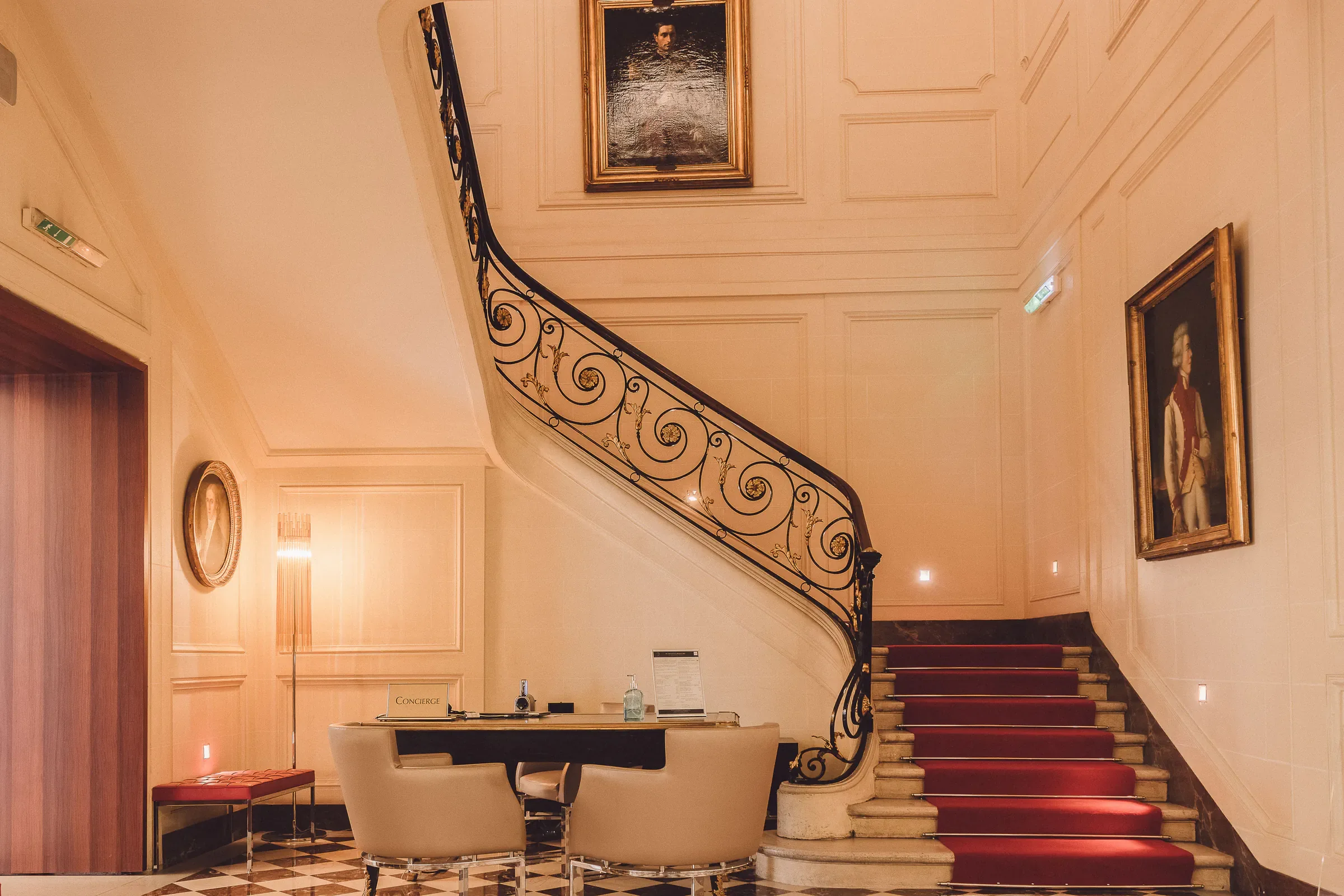
The Marquis de Sers has been dead for more than a century, but he and his family are still difficult to evict. His carriage entrance survives, so does the marble staircase, and along a gallery twenty-two metres long the family portraits hang where nobody can miss them. You can replace the furniture in a house like this. The ancestors are harder to move.
The mansion was built for him in 1880 and became a hotel in the 1930s. It now belongs to a family hotel group run by Anne and Agathe Jousse, a mother and daughter who are no relation of the marquis. They inherited the dilemma, not the title. Keep everything and you have a museum; change everything and you might as well have bought another house. Working with interior architect Pascal Allaman on the renovation completed in 2025, they found a more amusing arrangement.
You still enter where the carriages stopped, and the marble staircase still leads towards the marquis's former reception salon. But among the solemn family faces, Géraldine Prieur's graphic rugs announce that somebody else has the keys now. The ancestors look faintly startled, like relatives who went out for lunch and returned to find the furniture rearranged. They needn't worry. The walls are still theirs; the living have merely claimed the floor.
Upstairs, the family gives way to imaginary tenants: the occupants of a Paris apartment in the 1930s, with pale parquet, dark wood and the occasional daring fabric. There is enough atmosphere without turning every bedroom into a period set. Across the fifty-two rooms and suites, though, grandeur is not evenly shared. The smaller rooms are comfortable but hardly the size of a marquis's drawing room, and an Eiffel Tower view belongs to particular suites rather than to the address itself. At the top is a Marquis Apartment. The old owner may have lost the house, but he has kept a rather good room name.
The loveliest place to linger is neither grand nor new. Beyond the restaurant is a courtyard of citrus trees beneath a glass roof, where lunch can stretch until the expensive streets outside begin to feel rather unnecessary. It is easy to imagine this as the family conservatory, except that the family has long since gone and the restaurant welcomes people who are not staying at the hotel. A house once built for receiving still receives. It simply no longer asks anyone to be presented to the marquis.
There are limits to this domestic idea of luxury. This is a polished stretch of the eighth arrondissement, not a quarter of unexpected little discoveries, and the house does not try to be a palace with a day's entertainment under one roof. It is better at giving you somewhere to return to than at persuading you never to leave. That seems a sensible choice for a Paris address.
A good heir knows that keeping a house alive is not the same as keeping it unchanged. The marquis can have his portraits and his staircase. The living get the rest of the house.
A hotel since 1935
It has been a hotel far longer than it was a home.
Where the carriages turned in
Arrival still follows the order Jules Pellechet set out in 1880 for a Toulouse-born former hussar captain: through the carriage entrance, up the white marble staircase with its sculpted balusters and wrought iron, towards the reception salon and its original mouldings. For a guest the sequence does the work a lobby usually cannot. It establishes the scale of the house before any bedroom is seen, and it makes even a short check-in feel like being received rather than processed.
The corridor everyone uses
The gallery is not a showpiece to be visited once. It is the route from the lobby to breakfast, lunch and the bar, so its twenty-two metres are crossed several times a day. That is why the rugs matter: Géraldine Prieur's graphic designs do not stop at the gallery but carry on into the restaurant and S'Bar, a single thread laid from the front door to the last drink. The newcomers have taken the floor along the whole route.
The view belongs to the top
The Eiffel Tower is not a property of the address but of a few rooms near the roof. The top-floor suites take it in through tall windows and glass overhead, with private terraces that let the view in before the day has started. In the Eiffel Suite, 59 m² on the seventh floor, the second terrace even opens off the bathroom. Lower down, rooms look onto the avenue or the courtyard, which is the honest trade for booking the house rather than the view.
Sixty square metres under glass
Beyond the restaurant, the patio is the one ground-floor room that belongs to the weather without being at its mercy. Around 60 m² under a glass roof, with iron trellises and citrus trees, it is heated in winter and opened up in fine weather, so it stays in use through the year. Stefano Stafie's Mediterranean cooking suits it better than it would the salons: lunch here feels southern, even with the avenue a few steps away.
At a glance
Where
41 avenue Pierre 1er de Serbie, 8th arrondissement, in the Triangle d'Or between the Champs-Élysées and avenue Montaigne; George V (line 1) and Charles de Gaulle–Étoile about five minutes' walk
The house
Built in 1880 by Jules Pellechet for Henri-Léopold Charles, Marquis de Sers; enlarged in the early twentieth century; a hotel since 1935; renovated by Thomas Vidalenc in 2004 and by Pascal Allaman in 2025 for owners Anne and Agathe Jousse (B Signature)
Rooms
52 rooms and suites: Superior 20–24 m²; Deluxe 25–30 m²; Balcony Deluxe 24–28 m² with a furnished balcony; Prestige 33 m²; Executive Suite 23–40 m²
Signature suites
Eiffel Suite 59 m², seventh floor, two terraces with an Eiffel Tower view; Panoramic Suite 55 m², glass-roofed living room and a 180° terrace facing the Tower; Marquis Apartment 75 m², seventh floor, two terraces, kitchenette and dining area
Eating and drinking
Restaurant de Sers, Mediterranean cooking by Stefano Stafie, with a glass-roofed patio of citrus trees; S'Bar; tables can be booked by non-residents
Design and wellbeing
Graphic rugs by Géraldine Prieur from lobby to restaurant and bar; fitness room, massage room and sauna
The hotel's own history names some of the faces in the long gallery: Louis XV, Marie-Antoinette, Madame de Pompadour and the Comte de Chambord, the Legitimist pretender whose restoration failed in 1873. Whoever assembled the set, it reads less as a family album than as a declaration of loyalty to a vanished crown. That is worth knowing before walking it: this is a Bourbon corridor, and the modern rugs beneath it are taking sides.
02
Not every floor was his.
Early in the twentieth century the mansion gained an extra floor and a neighbouring building, and served as a health establishment before its 1935 conversion into a hotel. The marquis's house, then, is the ground-floor sequence of entrance, stair, salon and gallery. The bedrooms belong largely to later lives of the building. Book for the public rooms and the top-floor suites, not in the hope of sleeping in a nineteenth-century bedchamber.
03
Choose air over area.
About half the rooms and suites open onto a private terrace or balcony, and only some of those face the Eiffel Tower. The trade-off is plain in the room list: the Balcony Deluxe gives up floor space to the larger Prestige room but gains a furnished outdoor setting. In this part of the 8th, a few square metres of open air above the traffic do more for a stay than a wider room.
04
A house used to being remade.
The 2025 renovation is the second complete one in about two decades; Thomas Vidalenc led the previous remake in 2004. For years the house played the nineteenth-century private residence straight. Anne and Agathe Jousse chose instead to let the period show its seams, with modern rugs and 1930s references. Judge it as a design decision rather than a restoration: the inheritance here has always been curated by whoever owned it.
The price question
Hôtel de Sers charges for an address between the Champs-Élysées and avenue Montaigne and for an 1880 entrance sequence that is used every day, not roped off. What the money does not buy is a uniform experience: the grand rooms are downstairs, the smaller bedrooms are ordinary in size, and the Eiffel Tower belongs to a handful of suites. Book a terrace room or a signature suite and the house makes sense; book the smallest category for its own sake and it is mostly the address.
What the money buys
A carriage entrance, marble staircase and 22-metre gallery in everyday use.
A private terrace or balcony in about half the rooms.
A glass-roofed patio restaurant that also draws people from outside.
What it leaves out
An Eiffel Tower view outside particular suites.
Generous space in the Superior rooms, from 20 m².
A pool or a spa large enough for a whole afternoon.
Who it suits
Book it for a short, well-placed stay in a terrace room or a signature suite, with lunch on the patio. Look elsewhere for a self-contained resort day or a neighbourhood with small surprises.
Who should spend elsewhere
Hôtel Vernet
Same group, at 25 rue Vernet in the 8th near the Étoile: its restaurant sits beneath a glass roof attributed to Gustave Eiffel.
Hôtel Montalembert
Same group, at 3 rue de Montalembert in the 7th: a 1920s Beaux-Arts building with 50 rooms beside the Gallimard publishing house.
The Extra Edit
Confirmed with your quote
YOUR EXTRA
Something extra, from us.
Ask for a stay and a person takes it from there. Any hotel privileges that apply, and a personal Extra arranged by us, are confirmed with your bookable quote.
SipDrinks
SavourCulinary
DiscoverExperience
Tell us which Extra appeals in your request. Nothing is charged when you ask, and no upgrade is promised.
The Edit score is the editor's grade for the level of the hotel, out of ten. It weighs what the outside judges say (Michelin Keys, Forbes Travel Guide, World's 50 Best Hotels, Atout France palace status, La Liste), what changed in the last two years and what guests write now; where these and the editor's own judgement disagree, the editor decides. A spa with a pool worth booking for adds up to two tenths.
Why book through The Edit
Our personal Extra
A drink, a meal or an experience: chosen by you, arranged by us.