No payment now. A room preference is a request, not guaranteed availability. Personal confirmation within 24 hours.
1926 Opened
/50 rooms and suites
/2016 Renovated
Theprototype.
Every invention has a prototype. Most end up in museums, safely behind glass, no longer required to work. One of the prototypes of the Paris boutique hotel is still taking guests. It stands on rue de Montalembert, a short walk from the Seine, and has never felt obliged to remain exactly as it was invented.
The hotel opened in 1926, but its reputation was remade in 1990. Christian Liaigre, then better known for furniture than for hotels, was asked to furnish it at a time when Parisian luxury still ran to gilt, swags and tassels. He chose dark wood, leather and linen, and rooms that looked less like the apartments of royalty than those of someone with quiet, excellent taste. It was startling largely because it did not try to startle anybody.
The idea travelled. In 1997 Liaigre did the Mercer in New York, and a version of his calm spread through fashionable hotels far beyond Paris, until clean lines and expensive wood became the international language of not showing off. The Montalembert is often called the first boutique hotel in Paris. The precise claim is debatable; the influence is not. The trouble with inventing a look is that eventually everybody has it.
There was an obvious temptation to preserve the original, like a showroom in which nobody may move a chair. Instead, the Montalembert changed. Liaigre returned in 2011 to design a suite on the sixth floor, overlooking a quiet courtyard, and around the hotel's ninetieth birthday Pascal Allaman and Géraldine Prieur brought colour in: mid-century shapes, silk at the windows and patinated brass. The beige revolution had produced a hotel willing to live without beige.
What the copies missed becomes clear as soon as you settle downstairs. The old openwork lift climbs through the house like a birdcage, the bar has a fireplace, and the restaurant is not kept for residents. Writers and publishers have met here for decades, and a private room is called the Salon Gallimard, after the publishing house a few doors away. You can reproduce a sofa in another city. You cannot arrange for the same conversations to have been going on beside it for longer than most of the copies have existed.
Nor does the hotel insist on occupying your whole day. There is a small terrace for a drink, and outside a neighbourhood that rewards walking without a plan: the antique dealers around rue du Bac, the Musée d'Orsay and the streets running into Saint-Germain.
The rooms keep the proportions of an old Paris house. There are fifty of them, and a Superior can be as small as fifteen square metres, beautifully considered and still short of space for two suitcases. A small stone spa arrived in 2024, another reminder that the original was never meant to be frozen in time. This remains an intimate city hotel, not a palace with endless places to disappear.
Liaigre's great achievement was to make an expensive room feel like someone's home. The hotel has survived by understanding that a home changes as people live in it. The copies got the sofa. Only the original got the street.
A domestic first
The first hotel in Paris to put duvets on its beds.
A sitting room, not a lobby
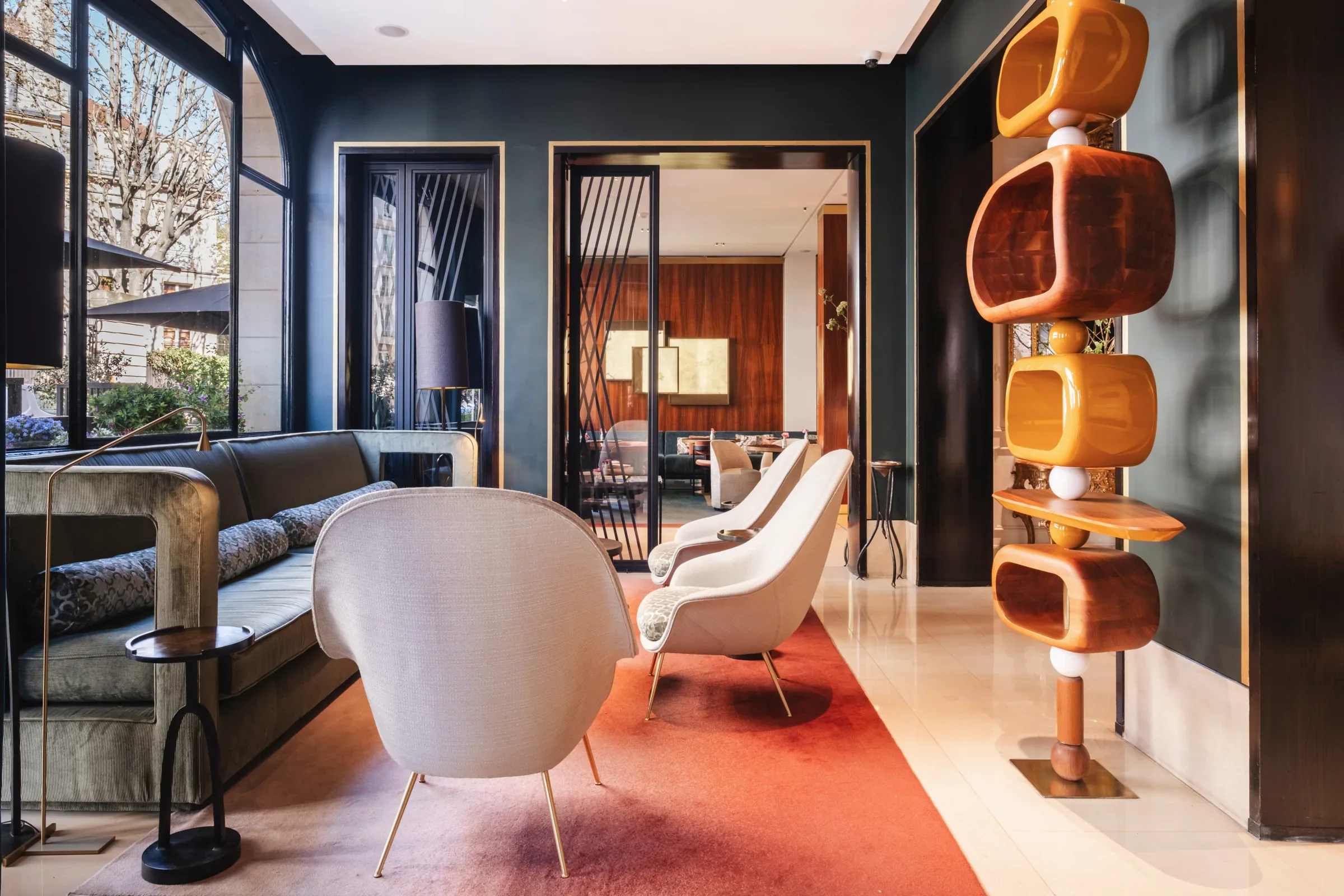
Downstairs is where the 1990 idea still does its work: arriving from the street means walking into a sitting room rather than a reception hall. The furniture has changed since Liaigre, and the colour now comes from later hands: a terracotta rug, a sculptural column of lacquered wood, armchairs in pale fabric. What survives is the proposition itself, a ground floor that behaves like a well-kept flat rather than a hotel lobby.
A room in the later colours
Upstairs the later house shows its hand. Ebony panelling runs behind the bed, brass inserts and a yellow throw pick up the colour that arrived around the hotel's ninetieth birthday, and tall windows bring in the light of the street. The proportions remain those of an old Paris house. Category matters more than décor here: the rooms run from about fifteen square metres up to suites, and the difference is felt in floor space rather than in finish.
The lift in its cage
The lift is the house's oldest piece of theatre: an openwork iron shaft rising through the stairwell, with the staircase winding around it beneath an arched window. It makes the journey upstairs part of the house rather than a box hidden behind a wall, and from the stairs the ironwork reads like a drawing. Taking the stairs instead is no hardship: the patterned runner and the light from above make the climb one of the better views indoors.
Eighty covers and a terrace
Dining room and terrace together hold about eighty people in 117 m², a scale that makes the restaurant a neighbourhood table rather than a destination hall. Under Cyril Russo in 2026 the kitchen cooks contemporary French food from the classic repertoire. The sunny, sheltered terrace is the part of the house that the street sees most, and the one that makes a fifty-room hotel feel like part of its neighbourhood.
At a glance
Where
3 rue de Montalembert, 7th arrondissement, near the Musée d'Orsay, Le Bon Marché and rue du Bac; nearest metro Rue du Bac (line 12), with Saint-Germain-des-Prés (line 4) also within walking distance
The house
Opened in 1926; furnished by Christian Liaigre in 1990; a sixth-floor suite by Liaigre added in 2011; renovated for its ninetieth year in 2016 by architect Pascal Allaman with interior designer Géraldine Prieur; part of B Signature Hotels & Resorts since 2016
Rooms
50 rooms and suites: Superior 15 to 18 m²; Deluxe 20 to 23 m²; Deluxe Balcony 20 to 23 m² with a private balcony; Junior Suite 27 to 32 m²; Suite 34 to 37 m²; two Suites Montalembert, 39 to 40 m², on the top floor with Eiffel Tower views
Eating and drinking
Restaurant du Montalembert, contemporary French cooking under chef Cyril Russo (2026), with a terrace; bar and lounge beside it; a fireside corner with a wood fire between the dining room and the patio
Wellbeing
Spa fitted out by Batiik Studio in natural stone and wood, opened in 2024, with Calma Paris treatments; gym with cardio and weight machines; no pool
Private rooms
Salon Gallimard, 10 m², for eight; the fireside corner, 25 m², for eight; restaurant and terrace together, 117 m², for 80
Why this one
01
A design history you can sit in.
The 1990 house that changed the Paris hotel.
02
A dining room for the street.
Restaurant, terrace and fire, open beyond the residents.
03
The Left Bank on foot.
Orsay, rue du Bac and Saint-Germain within a walk.
The Edit Notes
What a booking site will not tell you.
01
Space begins at Deluxe.
The Superior rooms run from 15 to 18 m², and the step to a Deluxe, at 20 to 23 m² with mouldings and ebony panelling, is the one that changes a stay for two. The Deluxe Balcony is the same size with a private balcony, the most useful upgrade in the house. The Eiffel Tower is a top-floor privilege: the hotel gives that view to its two signature suites, not to the rooms below.
02
The original was never only beige.
The calm of 1990 is remembered as a single palette, but the house as first described already mixed its moods: some rooms were furnished in a Louis-Philippe style alongside the contemporary ones, and the beds were made up in black-and-white stripes. Seen that way, the yellow and orange of the 2016 renovation is less a break with Liaigre than a return to a hotel that always held more than one idea of comfort.
03
Liaigre's suite is a chapter, not a category.
The suite Liaigre designed on the sixth floor in 2011 belongs to the hotel's history; the categories sold today are Superior, Deluxe, Deluxe Balcony, Junior Suite, Suite and Suite Montalembert, none under his name, and the bedrooms are credited to Pascal Allaman. Anyone booking for a room by Liaigre himself should ask what survives before arriving. His legacy is easier to find downstairs than upstairs.
04
A spa that suits an afternoon, not a programme.
The wellness floor is a recent addition, fitted out by Batiik Studio in natural stone, flowing wood and moiré patterns, with treatments by Calma Paris and a gym beside it. There is no pool and no circuit of heat and water to fill a day. It is a good reason to stay in for an hour after a museum, not a reason to choose this hotel over a larger house.
The price question
The Montalembert charges for an address, a history and a public floor that the neighbourhood still uses, not for square metres. The entry rooms are small, there is no pool and the house has few places to spread out. What the money buys is a Left Bank street, a working restaurant with a terrace and a lounge with a real fire. In a Deluxe or above it is fair value; in a Superior, only for a short stay or for one person.
What the money buys
The Musée d'Orsay, rue du Bac and Saint-Germain on foot.
A restaurant, bar and terrace shared with the neighbourhood.
A balcony in the Deluxe Balcony rooms; Eiffel Tower views in the two top-floor suites.
What it leaves out
Space for two in the 15 m² Superior rooms.
A pool or a full spa.
Large public rooms to disappear into.
Who it suits
Book it for a short, walking stay on the Left Bank in a Deluxe room or above. Look elsewhere for space, a pool or resort-style facilities.
Who should spend elsewhere
L'Hôtel
On rue des Beaux-Arts in the 6th: 20 rooms by Jacques Garcia in Oscar Wilde's last home, with a hammam pool below.
Relais Christine
On rue Christine in the 6th, since 1979: a Left Bank house with a Guerlain spa under thirteenth-century vaults.
The Extra Edit
Confirmed with your quote
YOUR EXTRA
Something extra, from us.
Ask for a stay and a person takes it from there. Any hotel privileges that apply, and a personal Extra arranged by us, are confirmed with your bookable quote.
SipDrinks
SavourCulinary
DiscoverExperience
Tell us which Extra appeals in your request. Nothing is charged when you ask, and no upgrade is promised.
The Edit score is the editor's grade for the level of the hotel, out of ten. It weighs what the outside judges say (Michelin Keys, Forbes Travel Guide, World's 50 Best Hotels, Atout France palace status, La Liste), what changed in the last two years and what guests write now; where these and the editor's own judgement disagree, the editor decides. A spa with a pool worth booking for adds up to two tenths.
Why book through The Edit
Our personal Extra
A drink, a meal or an experience: chosen by you, arranged by us.