No payment now. A room preference is a request, not guaranteed availability. Personal confirmation within 24 hours.
1928 Built
/96 rooms and suites
/57 of them suites
A treatyon the avenue.
On 25 June 1807, Napoleon and Tsar Alexander I went to a meeting that neither wanted to host. French carpenters had built a pavilion on a raft in the middle of the Niemen, with a French eagle on one weathercock and a Russian eagle on the other. The emperors set off from opposite banks at the same moment and arrived together. For three-quarters of an hour they talked in a room that belonged to neither of them. The peace treaty came in July. It did not last.
Paris has kept a more successful version of the arrangement. The avenue de Friedland, named after Napoleon's victory over the Russians that same June, leads away from the Arc de Triomphe. Shortly after the hotel opened in 1928, a Russian businessman called Alexander Pavlovich Kliaguine bought it as a wedding present for the young Parisian he loved, so that she would have somewhere grand enough to receive Paris. The hotel still belongs to his family. The tsar on the raft had been an Alexander Pavlovich too. A century apart, the two Alexanders managed rather different relations with France.
The Russians kept the keys; Napoleon got the walls. His portraits hang among those of his court, a copy of David's coronation painting presides over a fireplace, and Empire furniture fills the rooms with the conviction that history was more comfortable in silk. Crimson, gold and richly patterned fabrics make no attempt at neutrality. This is not a palace with a Napoleonic past but a hotel of the 1920s with a remarkably persistent Napoleonic imagination. If you prefer blank walls, the emperor will outnumber you.
Yet the place feels less like a monument than like the gift it once was. The bedrooms are not all dressed alike, and the suites have the generous sitting rooms of a house intended for entertaining. Fifty-seven of the ninety-six rooms are suites. The smallest bedrooms, though, start at seventeen square metres; the title of emperor does not enlarge a floor plan. The hotel is better at imagining a family receiving friends than at pretending every visitor has arrived with a court.
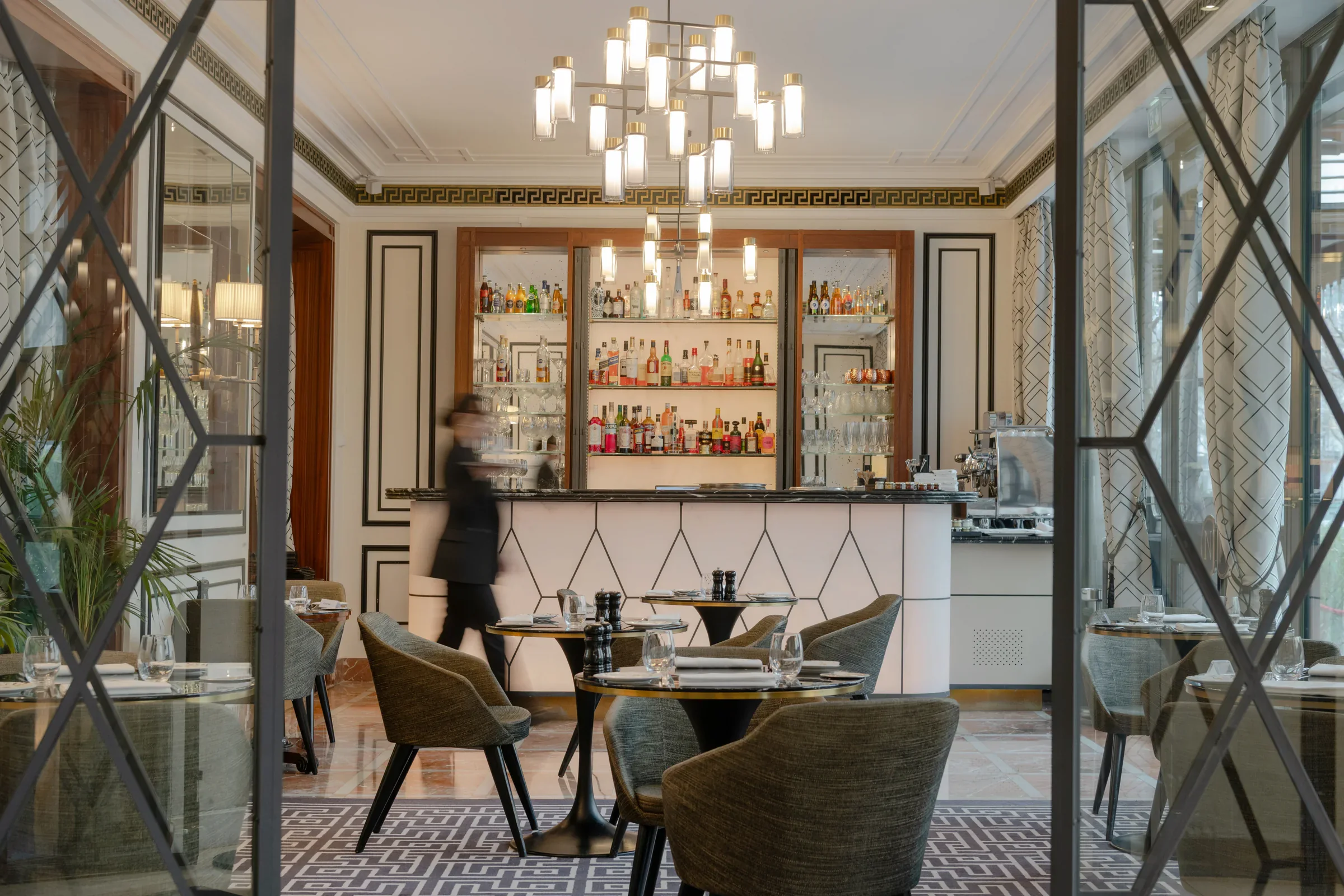
The bar, called 1807, seems to have negotiated a settlement of its own. Its lines are Art Deco rather than Empire, and its terrace looks onto the avenue instead of a battlefield. The name commemorates a triumph; the room is after an easier victory: a comfortable seat. Upstairs, the terrace of the Imperial Suite looks towards both the Eiffel Tower and the Arc de Triomphe, which Napoleon commissioned but never lived to see finished. The view is a little kinder to him than history was.
The avenue is busy, and the hotel cannot make the traffic of the Étoile disappear. Nor does it offer the elaborate ceremony of a palace. What it has instead is an oddly personal idea of grandeur: a hotel given for love, furnished in honour of a French emperor and kept by a Russian family. None of the parties would necessarily have agreed on the decoration. Somehow, they have made a home of it.
The peace of Tilsit survived only five years. The arrangement on the avenue de Friedland has lasted nearly a century, which makes it a more durable Franco-Russian treaty than any Napoleon managed, and the only one he had nothing to do with.
Before the hotel
It stands on the site of a Tolstoy family mansion.
A suite named for a prince
The Youssoupov Suite takes its name from Prince Felix Yusupov, whom the hotel lists among its past guests, and it is where the house's two loyalties meet in one room: a Russian name on the door, an Empire taste in the furnishings. Coral and cream upholstery fill the sitting room, and beyond it the bed stands beneath a draped red canopy. The suite shows how the hotel carries its theme: through fabric and colour rather than through museum pieces.
Seventeen square metres of drapery
The Superior room is the entry category, at 17 to 23 m², and the one many guests will book. The Empire treatment survives the reduction in scale through drapery rather than furniture, and each Superior has a marble bathroom with a bath, a shower or both. The real decision is the outlook: a courtyard planted with flowers, or the plane trees and traffic of the avenue de Friedland. One offers quiet, the other the city.
A terrace behind bamboo
Bar 1807 works in two registers: an Art Deco counter on one side, a fireplace on the other, so the room changes with the season and the hour. Its terrace on the avenue de Friedland sits behind a bamboo hedge under the plane trees. The same room serves breakfast, a light lunch and evening drinks, which makes it the hotel's ground-floor living room rather than a destination bar.
Two bedrooms on the seventh floor
The Imperial Suite occupies the seventh and last floor: 90 m², with a large living room, two bedrooms and two marble bathrooms, sleeping six. That makes it less a showpiece than a family apartment set on the roof, and its private terrace is the reason to book it. For a couple who want the tower without the extra bedroom, the three Eiffel Junior Suites have balconies facing it.
At a glance
Where
40 avenue de Friedland, 8th arrondissement; the Arc de Triomphe two minutes on foot, the Champs-Élysées three
The house
Built in 1928 in the Art Deco style by the architect Henri Porteau, on the site of a Tolstoy family mansion; bought shortly after opening by Alexander Pavlovich Kliaguine as a wedding gift, and still owned by his family
Rooms
96 rooms and suites, 57 of them suites: Superior 17 to 23 m²; Executive 22 to 26 m²; Junior Suite from 32 m² (Avenue, Terrace, Eiffel); Suite from 40 m²; Connecting 55 m²; Josephine Suite 75 m²; Yusupov Suite 85 m²; Imperial Suite 90 m² with a terrace
Eating and drinking
Bar 1807, with an Art Deco counter, a fireplace and a terrace on the avenue; Le Bivouac for breakfast and private events
Events
Function rooms named Laetizia, Elisa, Caroline, La Pagerie, Iena, Wagram, Friedland and Imperial; Friedland is the largest at 135 m²
Wellbeing
A fitness room reserved for guests; massages arranged on request
Why this one
01
A point of view.
Empire decoration, carried through without apology.
02
Room to sit.
Most of the house is suites.
03
The Étoile on foot.
The Arc de Triomphe two minutes away.
The Edit Notes
What a booking site will not tell you.
01
The Empire was chosen, not inherited.
The building is not an Empire relic. Henri Porteau designed it in the Art Deco style, and it was built in 1928. The paintings, lithographs and furniture from the Napoleonic period and the nineteenth century were selected by the owners. Read the decoration as a collection assembled by a family rather than as period architecture, and the differences between rooms make sense: they are an owner's choices, not a style guide's.
02
The Russian thread runs deeper than the purchase.
The site had a Russian name attached to it before the Kliaguines arrived: the hotel stands where a Tolstoy family mansion once stood. Among the past guests the hotel lists is Prince Felix Yusupov, the émigré aristocrat, and a sixth-floor suite of 85 m² now carries his name. The Franco-Russian story is not a theme laid over a French hotel; it is the more consistent of its two identities.
03
The Junior Suite is the sensible floor plan.
In a hotel where most rooms are suites, the Junior Suite, from 32 m², is where that advantage begins. It adds a living area with a sofa bed to the Empire woodwork and velvet, and comes in Avenue, Terrace and Eiffel versions. For a stay of more than a night or two, the step up from a Superior matters more than any upgrade above it: the essential change is a second place to sit.
04
Family-owned, but not alone.
The Kliaguine couple lived in the hotel for the rest of their lives, and ownership passed through later generations of the family. The hotel now also sells through Preferred Hotels & Resorts as part of its L.V.X. Collection. Independence here means ownership, not isolation: a family house with access to an international booking network, which is a practical strength rather than a compromise of character.
The price question
What the money buys at the Napoléon is an address two minutes on foot from the Arc de Triomphe, a decorative scheme carried through with conviction, and a high proportion of suites. It does not buy space at the entry level, a restaurant beyond the bar, or facilities beyond a fitness room. Book a Junior Suite or larger and the house makes its case; in a Superior room, the theme can feel bigger than the floor plan.
What the money buys
The Arc de Triomphe two minutes away on foot.
Empire decoration carried through rooms, salons and corridors.
Suites with separate sitting space in most of the house.
What it leaves out
Space in Superior rooms that start at 17 m².
A restaurant beyond Bar 1807.
A pool or a full spa.
Who it suits
Book it for a stay in a Junior Suite or larger, for anyone who wants a hotel with a story and a decorative point of view. Look elsewhere for minimal interiors, extensive wellness facilities or a quiet street.
Who should spend elsewhere
Hôtel Raphael
On avenue Kléber: built in 1925, run by the same family for four generations, with a rooftop terrace.
Hôtel Lancaster
On rue de Berri near the Champs-Élysées: a townhouse with a patio, a small private spa and interiors by Studio Jean-Philippe Nuel.
The Extra Edit
Confirmed with your quote
YOUR EXTRA
Something extra, from us.
Ask for a stay and a person takes it from there. Any hotel privileges that apply, and a personal Extra arranged by us, are confirmed with your bookable quote.
SipDrinks
SavourCulinary
DiscoverExperience
Tell us which Extra appeals in your request. Nothing is charged when you ask, and no upgrade is promised.
The Edit score is the editor's grade for the level of the hotel, out of ten. It weighs what the outside judges say (Michelin Keys, Forbes Travel Guide, World's 50 Best Hotels, Atout France palace status, La Liste), what changed in the last two years and what guests write now; where these and the editor's own judgement disagree, the editor decides. A spa with a pool worth booking for adds up to two tenths.
Why book through The Edit
Our personal Extra
A drink, a meal or an experience: chosen by you, arranged by us.