No payment now. A room preference is a request, not guaranteed availability. Personal confirmation within 24 hours.
1897 Built
/12 suites
/2016 Opened as a hotel
Two suitesto a floor.
In 1924 a two-year-old boy called Pietro Cardin arrived in Saint-Étienne with his family from a village near Treviso. France made a Pierre of him. Paris made him famous, then let him put his name on almost anything that could carry a label. He collected buildings, too, and one of them was a mansion on the rue du Cirque. It is a curious fate for a man who dressed the future that his former property should have ended up so fond of the past.
The house was built in 1897 and opened as the Hôtel Splendide Royal in 2016, when the Italian hotelier Roberto Naldi added Paris to a collection that already included Rome and Lugano. There are just twelve suites. From the street it is impeccably French: an emerald-green façade and a doorway that could belong to any private house in the 8th. Inside, pale panelling and gilded mirrors suggest that the future, if it ever came calling, was politely shown out again. Cardin's space-age fashions are nowhere in evidence.
Italy shows less in the decoration than in the scale. With so few rooms, the person who welcomes you can be called a maître de maison without seeming to have mistaken the hotel for a château. When the Splendide opened, guests were even encouraged to address the staff by their first names. In a house once owned by a man who made his surname famous, that is a particularly pleasing reversal. The Naldis have not put Pietro's name on the door. They have simply made the place less concerned with titles.
Upstairs, the suites resemble the apartments of well-behaved Parisian relatives: comfortable places to sit, classical furniture made by Italian craftsmen, and not much danger of being surprised by a chair. Even the smallest junior suites start at thirty-five square metres, with enough room to sit somewhere other than the bed. Some of the more theatrical hotels nearby have far more to show you. Here the interesting thing is how little the house feels obliged to perform.
The restaurant has the better claim to the Italian side of the family. Tosca takes its name from Puccini's opera, though before the music was written La Tosca was a French play, first staged in Paris. Its story was set in Rome; Italy supplied the score. Now a Roman chef, Paolo Ambrogio, cooks Italian food in the same Paris house. A French beginning, an Italian second act and dinner at the end: it is an unusually neat story for a restaurant to have stumbled into.
A house this small cannot do everything. Beyond Tosca, there is none of the procession of public rooms that makes a Paris palace a destination in itself. But on rue du Cirque, that seems less a deficit than the point: the Faubourg Saint-Honoré at one end of the street, the quiet of avenue Gabriel at the other, and an address that is content to be a home rather than a spectacle.
Pierre Cardin spent a lifetime turning Pietro into Pierre. On rue du Cirque, the house he once owned has made the return journey, without needing another label.
Six floors
Twelve suites, two on each floor.
Opposite a vanished circus
For a guest, this door is the whole threshold between a side street of the 8th and a house of twelve suites, and much of the quiet inside is borrowed from the street outside. The street once made more noise. Rue du Cirque, first called rue de Joinville, is named after the Cirque d'Été, the summer circus on the Carré Marigny opposite which it was cut, demolished in 1900 for the Universal Exhibition. For its first three years, this house of 1897 had a circus for a neighbour.
A salon that keeps the wine
With no procession of public rooms to fall back on, the Loggia has to do three jobs at once: lounge, salon and wine room, with the bottles kept in the room rather than out of sight below it. It is where guests can sit with a glass by the fire without going upstairs or booking a table. When the hotel opened, the cellar was presented as the guests' own, French and Italian bottles side by side: the house's two nationalities, settled on a single shelf.
The suite that becomes a flat
The Élysée Suite, at 62 m², is the house's largest regular category: a sitting room in pale panelling with tall windows, and the bedroom beyond. It leads a second life as well. Joined to a neighbouring Saint-Honoré junior suite, it becomes half of the Family Suite, about 105 m² with two bedrooms and two salons, the only way in a house of twelve suites to sleep a family of four behind a single door.
At a glance
Where
18 rue du Cirque, 8th arrondissement, between the Faubourg Saint-Honoré and avenue Gabriel; Miromesnil (lines 9 and 13) about 350 m, Champs-Élysées–Clemenceau (lines 1 and 13) about 550 m; Gare Saint-Lazare about 1.5 km
The house
An hôtel particulier built in 1897 for a single family, later owned by Pierre Cardin; opened as a hotel in 2016 by the Roberto Naldi Collection, which also has hotels in Rome and Lugano
Suites
12 suites over six floors: Junior Suite Parisienne 35 m²; Junior Suite Saint-Honoré 42 m²; Suite Parisienne 52 m²; Suite Élysée 62 m²; Family Suite of about 105 m², joining an Élysée Suite and a Saint-Honoré junior suite
Eating and drinking
Tosca, Italian and Mediterranean cooking by chef Paolo Ambrogio, with a ground-floor dining room and a separate room above for watching the kitchen; the Loggia Bar, a lounge and wine room with a fireplace
Wellbeing
No pool, gym or spa; in-suite massages and treatments, yoga and Pilates in the suite or at a fitness centre nearby
Service
A maître de maison, concierge, chauffeur transfers, private guides, multilingual babysitting; pets welcome
Why this one
01
Every room a suite.
Twelve of them, none under 35 m².
02
A private house in the 8th.
Between the Faubourg Saint-Honoré and avenue Gabriel.
03
Italy at the table.
Tosca, cooked by a Roman chef.
The Edit Notes
What a booking site will not tell you.
01
Choose the floor, not the label.
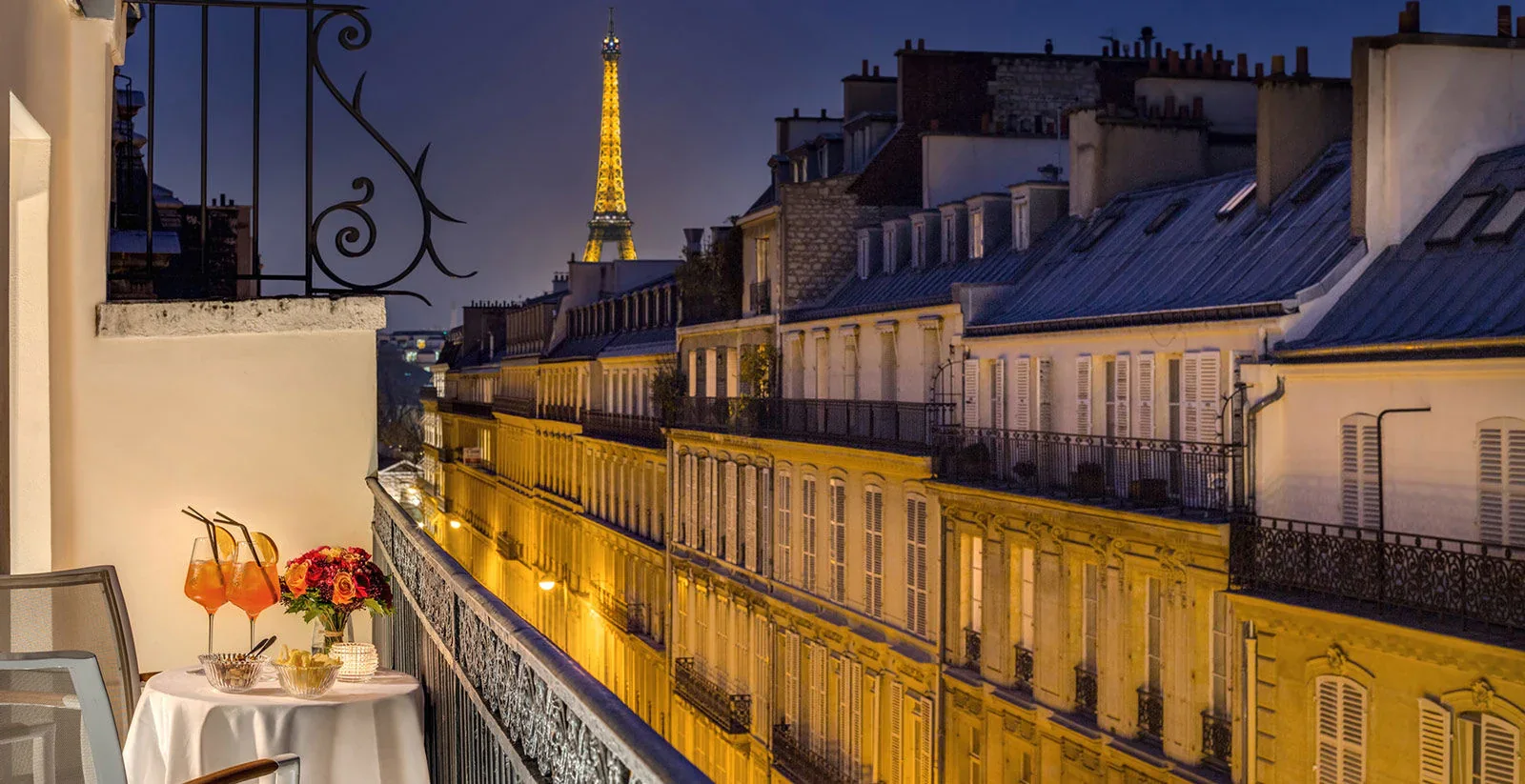
The conversion fitted two suites onto each of six floors in a building that narrows as it rises, so the plan changes from floor to floor more than from name to name. The Parisienne junior suites sit high up, on the fifth and sixth floors, facing the rooftops; the Saint-Honoré junior suites face rue du Cirque; a fifth-floor balcony looks towards the Eiffel Tower. In a house this small, height decides what the window frames.
02
The seclusion is inherited.
The Marquis de Rochegude, surveying the streets of Paris, recorded that André Le Nôtre, the gardener of Versailles, kept a country house on this ground in the 17th century, valued for its secluded position. The quiet the Splendide offers is therefore an old property of the site rather than a hotel invention. The conversion's real merit is restraint: by keeping the house to twelve suites rather than filling it with more rooms, the Naldis added little traffic to a site that has been sought out for exactly that absence.
03
A base, not a resort.
There is no pool, gym or spa, and no shared terrace. Their place is taken by services brought to the suite: massages, a yoga or Pilates teacher, or a session at a fitness centre nearby. In a building with two suites to a floor this is a sensible economy, and for travellers who spend the day in the city it costs nothing. For anyone who wants the hotel itself to fill a wet afternoon, it is a genuine limitation.
04
An Italian cook with French training.
Tosca has changed chefs more than once since it opened in early 2017. Paolo Ambrogio, in the kitchen since 2024, is Roman, but his career has run through French houses as well as Italian ones, including a Ducasse kitchen in Paris and Le Parc aux Crayères in Reims. That suits the building better than a straight import would: Italian food from a cook fluent in French service. Judge the restaurant by its present kitchen, not its past.
The price question
What the Splendide charges for is space and privacy: every key is a suite of at least 35 m², in a house with only twelve of them, a maître de maison rather than a front desk, and an address within walking distance of the Élysée, the Concorde and the Faubourg Saint-Honoré. What the money does not buy is infrastructure. There is no spa, no pool, no gym and no garden, and beyond Tosca and the Loggia little shared space. Pay for it as a private apartment with staff, not as a resort.
What the money buys
A suite of at least 35 m², whichever category is booked.
A house of twelve suites, run by a maître de maison.
The Élysée, the Concorde and the Tuileries on foot.
What it leaves out
A pool, a gym or a spa.
A garden or a shared terrace.
A sequence of public rooms to spend time in.
Who it suits
Book it for privacy and floor space in the 8th, and for Italian cooking downstairs. Look elsewhere for a hotel that is a destination in itself, with a spa and public rooms.
Who should spend elsewhere
Le Bristol Paris
On rue du Faubourg Saint-Honoré since 1925: a far larger house, with a courtyard garden and an indoor rooftop pool.
La Réserve Paris
On avenue Gabriel, a few minutes away: rooms and suites with a spa built around a 16-metre indoor pool.
The Extra Edit
Confirmed with your quote
YOUR EXTRA
Something extra, from us.
Ask for a stay and a person takes it from there. Any hotel privileges that apply, and a personal Extra arranged by us, are confirmed with your bookable quote.
SipDrinks
SavourCulinary
DiscoverExperience
Tell us which Extra appeals in your request. Nothing is charged when you ask, and no upgrade is promised.
The Edit score is the editor's grade for the level of the hotel, out of ten. It weighs what the outside judges say (Michelin Keys, Forbes Travel Guide, World's 50 Best Hotels, Atout France palace status, La Liste), what changed in the last two years and what guests write now; where these and the editor's own judgement disagree, the editor decides. A spa with a pool worth booking for adds up to two tenths.
Why book through The Edit
Our personal Extra
A drink, a meal or an experience: chosen by you, arranged by us.