No payment now. A room preference is a request, not guaranteed availability. Personal confirmation within 24 hours.
1913 A hotel since
/50 rooms and suites
/18 m² smallest room
Underthe glass.
In this part of Paris, the Eiffel Tower is sold by the angle. A glimpse between chimneys, a balcony on the right floor, a stretch of iron on the horizon: the view can become more important than the room. Hôtel Vernet, on a side street five minutes from the Arc de Triomphe, makes no great theatre of its windows. Its most interesting view is overhead.
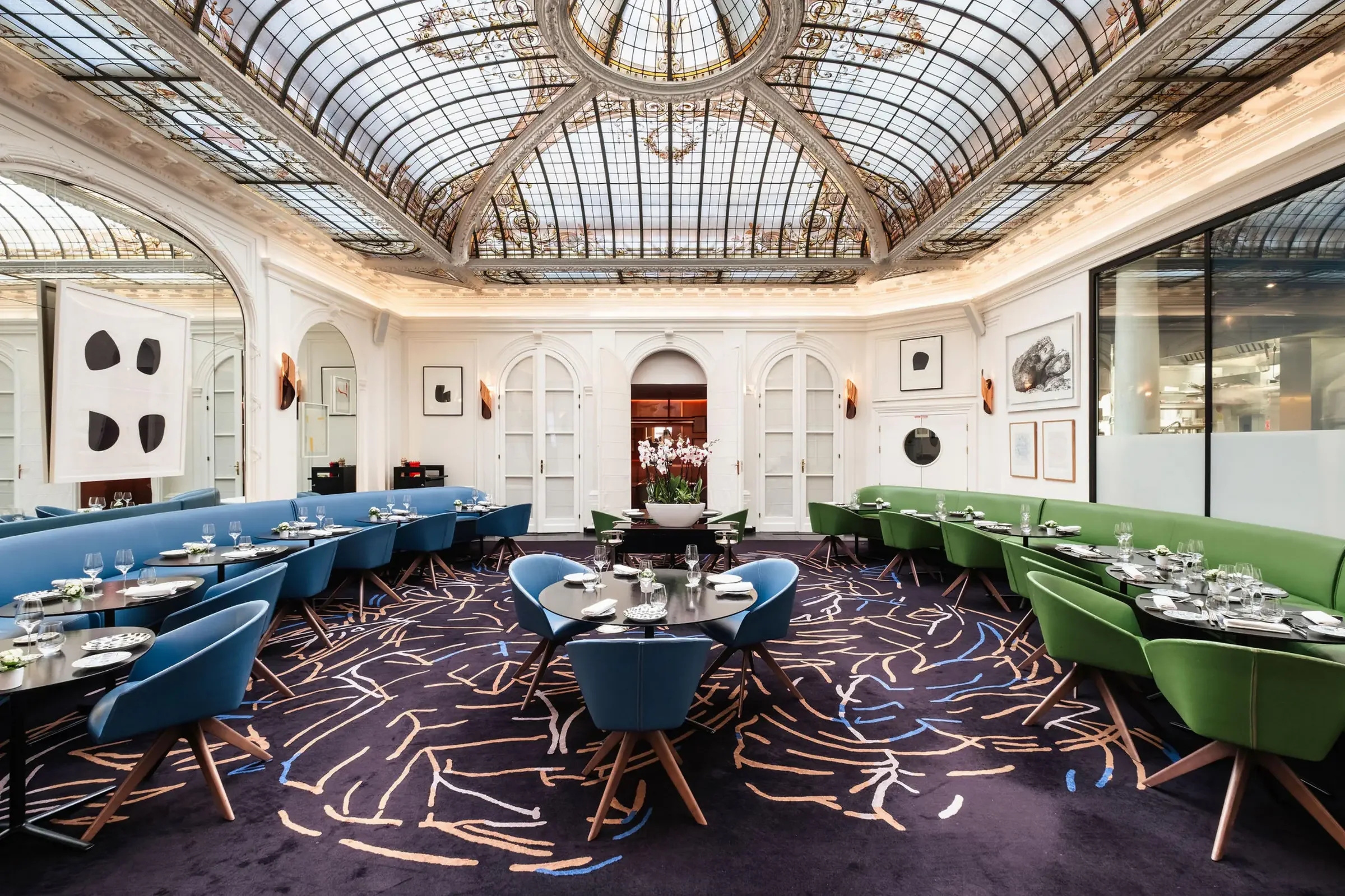
In Le V, the restaurant, stained glass by the master glazier Charles Champigneulle arches above the tables on an iron framework attributed to Gustave Eiffel. It is the same name attached to almost the opposite idea. The tower was made for a whole city to stare at; this roof was made for one dining room to sit beneath, letting daylight fall on the tables. It changes with the weather, and the clouds passing overhead do more for the room than another chandelier ever could.
The other reason to look up is in the bar. The painter Jean-Michel Alberola was given its ceiling, covered it in colour, then carried the patterns down into the carpet for good measure. Between the two, François Champsaur set a wavering counter of Carrara marble, as if hoping to restore some order.
The building, by Albert-Joseph Sélonier, has been a hotel since 1913. For its centenary, Champsaur was asked to make the interiors new without asking the old architecture to disappear. The arched doorways, mouldings and marble stayed; oak, quieter furniture and a little mischief arrived. Upstairs, the fifty rooms and suites have the composure of good Paris apartments, though not always their space. The smallest Superior rooms measure just eighteen square metres. A beautiful ceiling, it turns out, does not make the bedroom any larger.
Both of the Vernet's great rooms are shared with the city. Le V welcomes diners from outside, and anyone can come in for a drink under Alberola's ceiling. The privilege of staying is not having these rooms to yourself, but being able to take them for granted: coffee under the glass, one last look at the painted ceiling, then upstairs without stepping back onto the street. This is a house to return to after a day in Paris, not one that asks you to spend the whole day inside it.
That makes it a modest proposition for such an extravagant neighbourhood, and an appealing one. Around the Arc de Triomphe, the famous views are all outside. The Vernet keeps its spectacle indoors, where you can see it over a meal, a conversation or a glass. The tower asks Paris to look up from the pavement. At the Vernet, a chair will do.
Upstairs too
Each room has a mirror by Jean-Michel Alberola, the painter of the bar ceiling.
The kitchen behind the glass
For a guest, Le V is where the building's light is put to ordinary use: a business lunch, a long dinner, a coffee between appointments. The room keeps one more opening besides the roof. A large glazed wall gives diners a view into the kitchen, so the cooking happens in sight of the tables beneath the vault. Behind the dining room, a smaller salon set apart from the main floor takes around ten guests, for a meal that wants the house without the audience.
Copper behind the counter
The bar is the hotel's evening room, small enough for a conversation to set its volume. What the ceiling tends to hide is the wall behind the counter: a tall screen of vertically pleated copper, made in the workshop of the metalworker François Pouenat. Nearby stands a marble-and-brass chimneypiece kept from the old house. Between them, the room holds both of its centuries in one view, with the new metal and the original fireplace given the same attention.
Two sets of doors from the street
Arriving from rue Vernet, past the stone front with its curved balconies and Art Nouveau awning, a guest crosses a double set of doors before the lobby opens: a short pause between pavement and house. Inside, white columns carry the arches and the floor is Carrara marble. The discovery is in the glass. Champsaur had the panels brushed with blanc de Meudon, a fine white chalk, so that light shifts across them as people move through.
Eighteen square metres, courtyard side
The Superior room, 18 m², is the way in, and it faces the courtyard rather than the street: quiet bought at the price of an outlook. The room's answer to its size is a curved oak screen that serves as the bathroom door, folding into the wall rather than swinging out across the floor, with a marble bathroom and walk-in shower behind it. The next category up, Deluxe at 25 m², may face either courtyard or street.
At a glance
Where
25 rue Vernet, 75008 Paris, on a side street between the Champs-Élysées and the Étoile, a few minutes on foot from the Arc de Triomphe
The house
A building by Albert-Joseph Sélonier, a hotel since 1913; interiors renewed for its centenary by François Champsaur, completed in 2014; owned by the family group B Signature Hotels & Resorts
Rooms
50 rooms and suites: Superior 18 m², courtyard side; Deluxe 25 m²; Executive and Executive Balcony 30–35 m²; Prestige 40–42 m²; Executive Suite 45 m²; Prestige Suite 55 m², two with terraces; Family Suite 70 m²; 2-Bedroom Suite 80 m²; 3-Bedroom Suite 100 m²
Eating and drinking
Le V, beneath a glass roof attributed to Gustave Eiffel, with Mediterranean cooking by chef Baldassare Mazzara and a private salon for around ten; the Bar & Lounge beneath Jean-Michel Alberola's painted ceiling
Wellbeing
A naturally lit fitness area, private classes and personal trainers; massages and hairdressing in the room; no spa or pool
Services
Concierge team including Clefs d'Or members; connecting rooms, cots and babysitting for families; pets welcome; chauffeur and valet parking; bicycles and scooters on request
Why this one
01
A roof to eat under.
Le V's glass vault, attributed to Eiffel, lights the dining room.
02
A painted ceiling.
Alberola's colour overhead, a marble counter below.
03
A building kept, not erased.
Arches, marble and mouldings from 1913, with new oak.
The Edit Notes
What a booking site will not tell you.
01
The rooftops belong to a few rooms.
Only two kinds of room give a guest Paris in the open air: the Executive Balcony rooms, 30 to 35 m², with a table and two chairs above the street, and the two Prestige Suites, 55 m², that have private terraces over the Haussmann roofline. Everything else is seen through glass. For a hotel whose public rooms are about looking up, these are the only rooms where looking out is part of the deal, and they are worth asking for by name.
02
One painter, street to bedroom.
Jean-Michel Alberola's hand does not stop at the bar. He drew the long carpet that runs through the lobby and designed the mirror that hangs in the rooms, so the same artist meets a guest at the door, at the counter and at the desk upstairs. That thread matters more than any single work: it is what makes the public rooms and the bedrooms read as one house rather than a showpiece with lodgings attached.
03
No spa, and no pretence of one.
The Vernet has no pool and no spa floor. What exists is a fitness area lit by daylight, private classes and trainers through the concierge, and massages or hair appointments in the room. That is a real limitation in a part of Paris where competing houses have built pools underground. It is also consistent: this is a base for a city, and a guest who needs a long swim each morning should stay elsewhere.
04
The big suites are joined rooms.
Above the Prestige Suite, the largest units are assemblies rather than grand apartments. The Family Suite, 70 m², is two connecting rooms; the 2-Bedroom Suite, 80 m², and the 3-Bedroom Suite, 100 m², are built the same way from connecting bedrooms. For a family that wants separate doors and a shared corridor, that is exactly right. For a couple hoping for one set-piece suite with a salon of its own, the Prestige Suite is the better choice.
The price question
The Vernet charges for an address near the Étoile and for two public rooms of genuine historical interest, and it delivers both. What the money does not buy is space in the entry rooms, an outlook from them, or any of the facilities that larger houses nearby treat as standard. Book a Deluxe room or above, or one of the balcony categories, and the bargain holds. Book the smallest room for the ceilings alone and the trade feels thinner.
What the money buys
A dining room beneath a historic iron-and-glass roof.
A bar painted overhead by a living artist.
The Arc de Triomphe and the Champs-Élysées on foot.
What it leaves out
Space or a street outlook in the 18 m² Superior rooms.
A spa or a pool.
Public rooms kept for residents alone.
Who it suits
Book it as a handsome, central base for a stay spent out in the city, in a Deluxe room or above. Look elsewhere for a resort-style house with a pool.
Who should spend elsewhere
Hôtel Balzac
At 6 rue Balzac: fifty-eight rooms and suites, a lounge beneath a glass roof and a small spa with a pool.
Hôtel Lancaster
At 7 rue de Berri: a private mansion built in 1889 and a hotel since 1925.
The Extra Edit
Confirmed with your quote
YOUR EXTRA
Something extra, from us.
Ask for a stay and a person takes it from there. Any hotel privileges that apply, and a personal Extra arranged by us, are confirmed with your bookable quote.
SipDrinks
SavourCulinary
DiscoverExperience
Tell us which Extra appeals in your request. Nothing is charged when you ask, and no upgrade is promised.
The Edit score is the editor's grade for the level of the hotel, out of ten. It weighs what the outside judges say (Michelin Keys, Forbes Travel Guide, World's 50 Best Hotels, Atout France palace status, La Liste), what changed in the last two years and what guests write now; where these and the editor's own judgement disagree, the editor decides. A spa with a pool worth booking for adds up to two tenths.
Why book through The Edit
Our personal Extra
A drink, a meal or an experience: chosen by you, arranged by us.