No payment now. A room preference is a request, not guaranteed availability. Personal confirmation within 24 hours.
99 seats in the cinema
/23 metres of pool
/1,500 m² of spa
The room isthe programme.
The cinema at Le Royal Monceau has ninety-nine seats, all of them grey except one, which is red. It is there, the hotel says, to make people ask why. The walls around it are lined with small white ceramic eyes. It is a fair introduction to everything upstairs: a hotel that would rather set its guests a question than answer one they never asked.
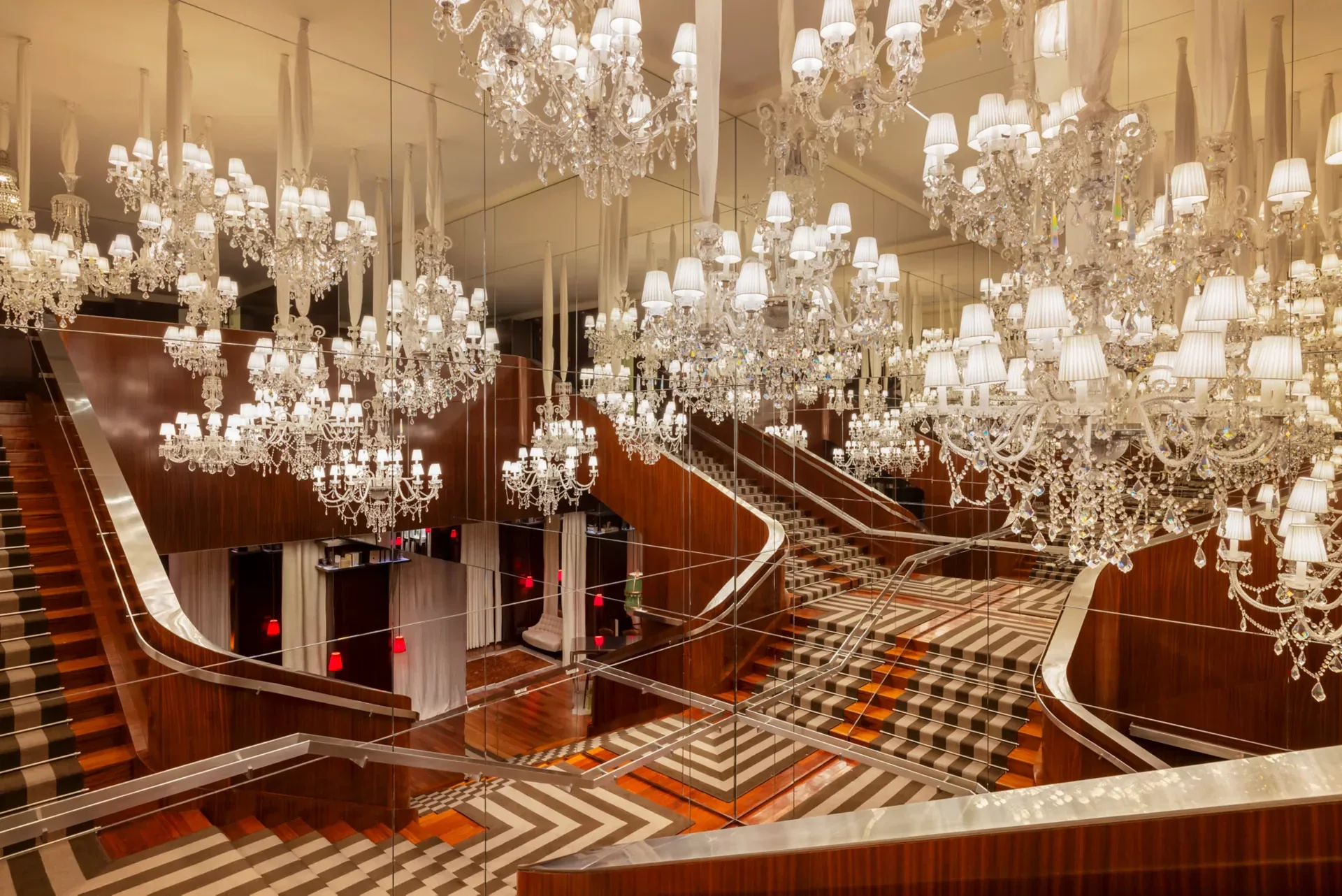
It started with hammers. In June 2008, before the old hotel of 1928 was gutted, its new owners threw a demolition party. Well over a thousand invited guests arrived in white overalls, rubber boots and orange helmets, and each was handed a hammer. One reporter needed more than five minutes to knock a hole the size of a fist between rooms 427 and 429. Twenty-two artists took over a room each on the first floor; in one of them, a hammer struck a wine glass all evening and never broke it. The furniture was auctioned off that same month, although Philippe Starck kept the Baccarat chandeliers, which now hang in a cluster above the staircase.
Starck's starting point for the new hotel was a complaint. A hotel room, he said, is empty, terribly empty, and it takes days to fill. So he did some of the filling himself. Framed pictures lean against the walls as though waiting to be hung. Every room has an acoustic guitar, every desk a map of Paris annotated in his hand, and old photographs hide behind the bathroom mirrors. He said he hoped guests would leave something of their own behind: a poem, a drawing, a love note.
The questions this raises are handled by staff with unusual job descriptions. The hotel appointed what it calls the first Art Concierge in Paris, and Julie Eugène has held the post since 2010. She got there by helping a street artist install his work at the demolition party. Her job is to open doors in the art world for guests, and the hotel gives her plenty to work with: an art bookshop, a collection of more than three hundred works, a herd of wooden deer by Nikolay Polissky on a first-floor landing and a giant teapot by Joana Vasconcelos in the garden.
The cinema is the room to use. It retains 35 mm projection, and since August 2026 it has opened to the public one Sunday a month, so the red seat may well be taken by somebody from the neighbourhood. The restaurants keep up the game. Il Carpaccio is reached along a corridor lined with mother-of-pearl shells, Matsuhisa sits behind a wall built from sake bottles, and a twenty-three-metre pool gives the evening something calmer to end on.
The wit dates from 2010, and a few of its jokes have now been told for a while. Rooms full of frames, books and instruments suit a guest who likes to be entertained more than one who wants a blank page. The hotel stands on a smart, quiet avenue near the Étoile, not on the river, and the walk to the Seine takes about twenty minutes.
The old hotel was handed over to guests with hammers. Its replacement needs only one red seat to make an otherwise orderly room feel slightly unfinished.
One Thai boxing studio
In the spa, beside the 23-metre pool and a Pilates room fitted with Reformer and Cadillac machines.
Ninety-nine armchairs
The Katara Cinema is a full auditorium, not a screening lounge: ninety-nine leather armchairs designed by Philippe Starck, and projection in 3D as well as 2D, so a new release can be shown here as in a commercial house. The hotel lists it with its three reception salons and presidential suites as a place to hold an event, so the room can be taken for a private screening, a presentation or a party. For the film club and in-house screenings, the popcorn comes from Pierre Hermé.
Forty square metres, already furnished
The Deluxe Collection Room, 40 m², is the second category and the one most guests will see, and it arrives stocked: a selection of books chosen by the hotel's own art bookshop, pieces from the private collection on the walls, an acoustic guitar and the art concierge's newsletter. The room becomes a branch of the building's programme rather than a retreat from it. One practical discovery: the hotel's butler service starts here, not in the suites, from the first category up.
One long table
Le Bar Long is named for its centrepiece: a single long table of white onyx and glass, made by Perrin & Perrin, at which strangers sit side by side on leather and wood stools. It works as the hotel's brasserie as much as its bar, with classic Parisian dishes, tapas and cocktails, and live music on certain evenings. Of the hotel's public rooms it is the least formal, and the one where residents and people from the neighbourhood are most likely to end up seated at the same table.
Twenty-three metres in daylight
The pool lies at the centre of a 1,500 m² spa, lit by natural light and watched by a lifeguard, with a separate watsu pool for floating treatments. Around it the spa is unusually athletic for a hotel: four fitness studios, a Pilates room and a private Thai boxing studio. The treatment menu changed with the brand: the former Clarins spa now works with Dr Barbara Sturm, 111Skin and Nooance across seven rooms. Children staying at the hotel may swim at set times with a parent.
At a glance
Where
37 avenue Hoche, 75008 Paris, near the Étoile; Arc de Triomphe and Champs-Élysées a short walk; about 45 minutes from Roissy-Charles de Gaulle and Orly, 15 to 20 minutes from Gare du Nord
The house
Opened on 1 August 1928 by Pierre Bermond and André Junot; closed in 2008 for two years; reopened on 18 October 2010 as Le Royal Monceau – Raffles Paris, interiors by Philippe Starck; Raffles is part of Accor
Rooms
149 rooms and suites: Artist Room 36 m²; Deluxe Collection Room 40 m²; Junior Suite 58 m²; Gallery Suite 68 m²; Signature Suite 72 m²; Lifestyle Suite 95 m²; Prestige Suite 115 m²; Ray Charles Suite 118 m²; Penthouse Suite 167 m²; Royal Monceau Suite 190 m²; Avenue, Raffles and Katara Presidential Suites 278 to 348 m²
Eating and drinking
Il Carpaccio, opening onto a glass conservatory, chefs Oliver Piras and Alessandra Del Favero (since 2021); Matsuhisa Paris (2016), executive chef Emanuele Bombardier (since 2022); Le Bar Long; La Cuisine with a terrace in warm weather; Viñales Lounge; pastry by Yazid Ichemrahen and Alexandre Favre
Wellbeing
Raffles Spa & Wellness, 1,500 m²: heated 23-metre pool in natural light with a lifeguard, watsu pool, hammam, laconium, ice fountain, sauna, seven treatment rooms with Dr Barbara Sturm, 111Skin and Nooance; four fitness studios, Pilates room, Thai boxing studio
Art and film
Art Concierge service; private collection of more than 300 works; Art District gallery with changing exhibitions; Librairie des Arts; Katara Cinema, 99 Starck leather seats, open to the public through the monthly Royal Film Club
Why this one
01
A cinema with ninety-nine seats.
Open to the public once a month.
02
An art service that opens doors.
Studio visits, collectors, private museum hours.
03
A 23-metre pool in daylight.
Inside a 1,500 m² spa.
The Edit Notes
What a booking site will not tell you.
01
The garden is written into the suites.
The hotel publishes an outlook only from the Junior Suite upwards. Junior and Gallery Suites may face the city, the courtyard or the garden; the 72 m² Signature Suite is the one category listed with courtyard, garden or patio and no city option at all. From the Prestige Suite to the presidential suites, the listing gives city views only. The two room categories, of 36 and 40 m², state no outlook. A guest who wants the inward, quieter side should book the Signature Suite and say so.
02
A screening room that is rarely free.
The Katara Cinema is not an amenity to be switched on after dinner. Most of the time it serves previews, private events and the film trade. The public way in is the Royal Film Club, one screening a month, with tickets sold to anyone. For a resident who wants the room, the useful question to the concierge before arrival is whether a club night or a free evening falls within the stay; otherwise the cinema may stay closed.
03
The collection is quieter than its showpieces.
The deer and the teapot get the attention, but the hotel's own description of its collection is mostly fine-art photography, hung through corridors and rooms, with portraits of Ray Charles by Arlette Kotchounian in the suite named after him. The art concierge works outward rather than inward: studio visits, collectors, museums opened outside public hours, and an art newsletter left in each room. The service earns its keep in the city; the building is the starting point, not the destination.
04
Residents share the tables with Paris.
Il Carpaccio and Matsuhisa both take bookings from outside the hotel, and both are run by names with followings of their own: Il Carpaccio by Oliver Piras and Alessandra Del Favero since 2021, with a menu developed with Da Vittorio of Brusaporto; Matsuhisa, open since 2016, by executive chef Emanuele Bombardier since 2022. Neither is held back for residents. Anyone staying for a particular dinner should reserve the table when booking the room rather than on arrival.
The price question
The money buys an interior that does the entertaining, an art concierge with access the city does not offer at the door, two restaurants Paris travels to, butler service from the first room category and a 1,500 m² spa. It does not buy the river, a monument in the window or an empty room. Hotels on the Seine sell the view; this one sells what is inside. Pay for a suite if the outlook matters.
What the money buys
A 1,500 m² spa with a 23-metre pool, watsu pool and Thai boxing studio.
An art concierge, an art bookshop, a gallery and a 99-seat cinema.
Il Carpaccio and Matsuhisa without leaving the building.
What it leaves out
Any published river or monument view.
A stated outlook for the two room categories.
A plain room: every one comes furnished with Starck's ideas.
Who it suits
Book it for a city stay in which the hotel's own programme, the art services, the spa and the restaurants are the plan. Look elsewhere for the Seine, a classical interior or a room left blank.
Who should spend elsewhere
Le Bristol Paris
On rue du Faubourg Saint-Honoré in the same arrondissement, with a courtyard garden and a rooftop pool looking towards Montmartre and the Eiffel Tower.
Hôtel Lutetia
On boulevard Raspail on the Left Bank, a hotel since 1910 and now part of Mandarin Oriental, with a brasserie, two bars and a spa.
The Extra Edit
Confirmed with your quote
YOUR EXTRA
Something extra, from us.
Ask for a stay and a person takes it from there. Any hotel privileges that apply, and a personal Extra arranged by us, are confirmed with your bookable quote.
SipDrinks
SavourCulinary
DiscoverExperience
Tell us which Extra appeals in your request. Nothing is charged when you ask, and no upgrade is promised.
The Edit score is the editor's grade for the level of the hotel, out of ten. It weighs what the outside judges say (Michelin Keys, Forbes Travel Guide, World's 50 Best Hotels, Atout France palace status, La Liste), what changed in the last two years and what guests write now; where these and the editor's own judgement disagree, the editor decides. A spa with a pool worth booking for adds up to two tenths.
Why book through The Edit
Our personal Extra
A drink, a meal or an experience: chosen by you, arranged by us.