No payment now. A room preference is a request, not guaranteed availability. Personal confirmation within 24 hours.
115 rooms and suites
/1756 royal stud from
/2005 horses left
Saddle leather,stable walls.
Bas-Rhin, France48°35′ N 7°44′ E
For two and a half centuries, the best-looked-after residents of this corner of Strasbourg had four legs. The royal stud farm on the old city ramparts housed stallions, and the last of them left in 2005. Their successors are a more varied crowd. Some are on a city break. Others are surgeons from around the world, in town to train at the research institute next door, which runs the hotel. The person buttering a croissant at the next table may well have spent the previous day practising keyhole surgery.
Les Haras is what became of the stables: a design hotel in a listed building, within easy walking distance of Petite France and the cathedral. The institute, IRCAD, took on the buildings from the city and brought in the Paris designers Jouin Manku, who kept the sandstone and the great timber roofs and filled the spaces beneath with oak and saddle leather. The hotel has since spread into a neighbouring former hospital once run by nuns, and now has more than a hundred rooms.
The horses have gone, but the tack room never quite left. Leather from a tannery in the Alsatian foothills wraps around the bedheads like a saddle, and the bathroom doors open with simple leather straps. It is a quiet, handsome way of remembering who lived here first. Guests sleep roughly where the stallions did, on considerably better bedding.
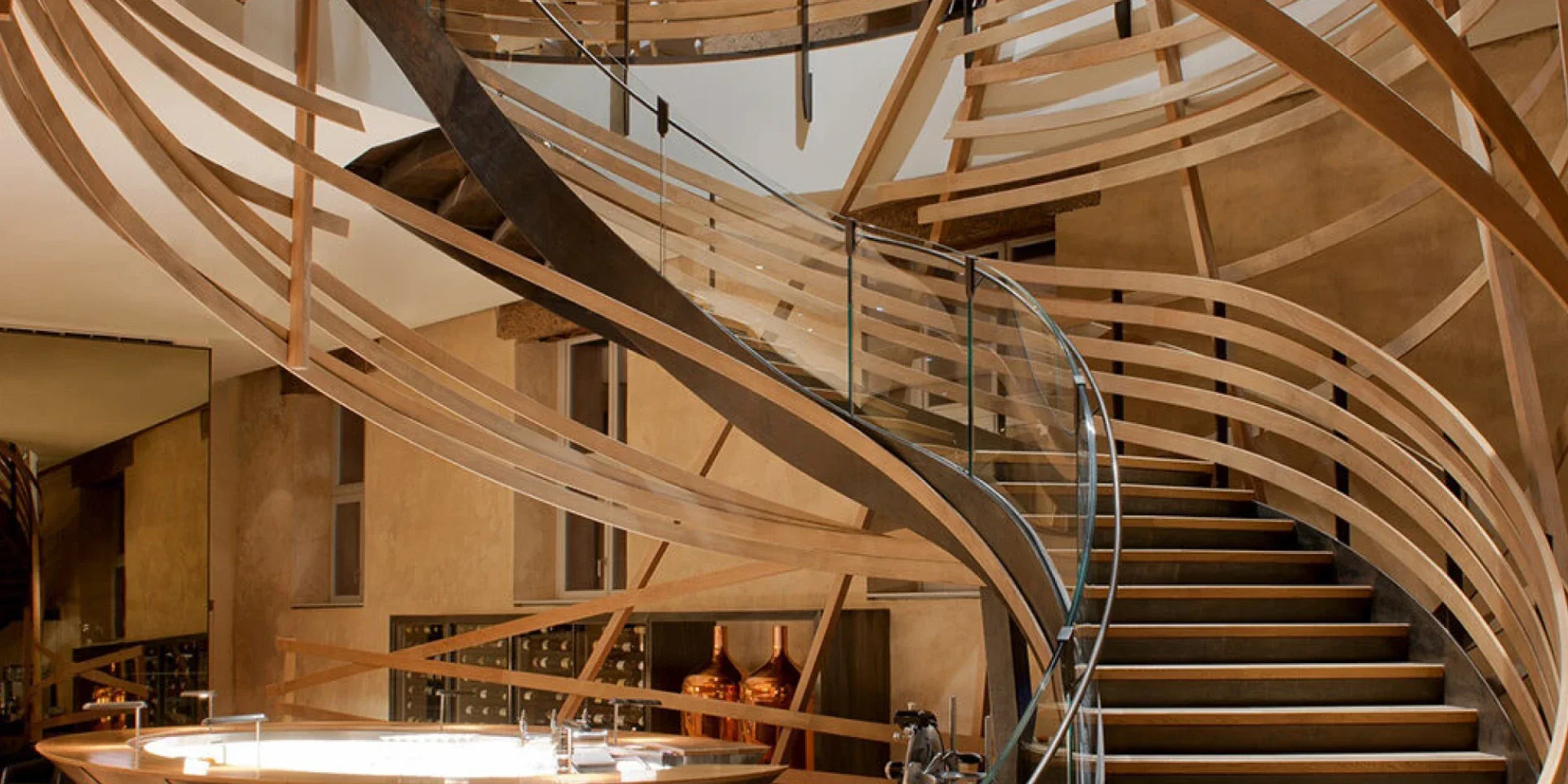
The former stables are home to the Brasserie des Haras, run by Marc Haeberlin of the Auberge de l'Ill and his chef François Baur. A staircase of oak and black steel swirls six metres up to the dining room beneath a timber roof as tall as a church nave, and the cooking is chic bistro with real ambition. Beef cooked in hay has turned up on the menu over the years, which seems only fair in a building that smelled of it for so long.
Away from all that energy, a minimalist spa of oak and Vosges sandstone offers a long lap pool and a relaxation room looking out onto the park. The bar spills into an inner courtyard. Both are very welcome after a day of sightseeing.
With a research institute next door and meeting rooms on site, the lobby can feel distinctly professional on weekdays, and the hotel is larger than a typical boutique address. The trade-off is a superb location and a brasserie good enough to justify the visit by itself. It is a natural choice for a design-minded weekend in Strasbourg, especially for travellers who like to walk to a cathedral and back to a very good dinner.
It was built as a stable, and in the other sense of the word it still is one. In a busy city full of visitors, it is a calm, steady house, the sort of place that keeps its head. Surgeons appreciate that. So, presumably, did the horses.
Royal stud
In 1756, at the request of the Marquis d'Argenson, the Royal Stud moved into the municipal riding academy built here four years earlier; the horses left for good in 2005.
The staircase in the great stable
The Brasserie des Haras fills the former great stable, one of the parts of the stud farm listed in 1922. Its bar lounge sits beneath a monumental curved staircase designed by Jouin Manku, which climbs to the upstairs dining room for up to 120 under the eighteenth-century timber roof. A yurt of leather, modelled on a saddle, can be closed off as a private room.
A Deluxe room
The Deluxe rooms, of 25 to 34 m², share the house vocabulary: wooden floors, linen and cotton, custom furniture by Jouin Manku and a bedhead that curves round the bed in saddle-stitched leather. Bathrooms have a walk-in shower or a bath. Some Deluxe rooms connect with a Suite, making an apartment for up to five people.
The pool in the new wing
The spa occupies the nineteenth-century extension, reached from the historic buildings through a restored tunnel. The indoor pool is lit by daylight from a garden sunk into the ground, with walls of stone; Corian shells along the edge hold an experience shower, the hammam and the sauna. A separate relaxation room opens onto the same garden through a wide window.
The courtyard
The hotel bar is in the little stable, and when the sun is out it moves into the inner courtyard of the stud farm, with large armchairs set out on the lawn under old trees. In winter the bar serves hot drinks and pastries indoors. The Brasserie's own terrace occupies another side of the courtyard, paved with Rhine pebbles and laid with tables.
At a glance
Where
23 rue des Glacières, 67000 Strasbourg, Bas-Rhin; at the entrance to the Petite France district, on the line of the medieval ramparts, between the university hospital, where IRCAD has its seat, and the historic quarter. Site of just over a hectare. Central station 2 km; Strasbourg-Entzheim airport 16 km, Baden-Airpark 60 km, Basel-Mulhouse EuroAirport 130 km
The stud farm
Built in the mid-eighteenth century along the medieval ramparts; municipal riding academy from 1752, with the covered riding school, the old stable and lodgings by the architect Jacques Gallay; Royal Stud from 1756 at the request of the Marquis d'Argenson. Facades, roofs, monumental portal and great stable listed as historic monuments in 1922. The horses left in 2005; the city entrusted the restoration and operation of the site to IRCAD, works began in 2010 and the hotel opened in 2013. The former riding school now houses IRCAD's biocluster of medical start-ups
Design and operation
Restoration by the architects Denu et Paradon, interiors and furniture by Patrick Jouin and Sanjit Manku, who also designed the brasserie and the extension. Natural materials throughout: wood, leather, linen and cotton, with saddle stitching and a protective curved bedhead. Hotel management by Jean-Pascal Scharf's Sogeho; revenue from the site helps fund IRCAD's research
Rooms and suites
115 in all: 55 in the stud buildings from 2013, 60 added in the extension, a nineteenth-century former clinic of the Deaconess sisters across a street, linked by a restored tunnel. In the new rooms the lampshades are folded like the sisters' coif and bathrooms are lined like bamboo cabinets; top-floor rooms have exposed beams and a courtyard view. Classic up to 26 m², Superior 22 to 26 m², Deluxe 25 to 34 m², Junior Suite 31 to 41 m² for up to three, Suite 30 m² with living room and convertible sofa; some Suites connect for up to five
Eating and drinking
Brasserie des Haras in the former great stable, an independent restaurant with Marc Haeberlin of the Auberge de l'Ill and a menu by chef François Baur: dining room upstairs for up to 120 under the eighteenth-century timber roof, a leather yurt modelled on a saddle, a bar lounge beneath the monumental staircase with 120 wines, and a courtyard terrace on Rhine pebbles for up to 100; open every day. Hotel bar in the little stable, spilling into the courtyard in sunny weather. Breakfast room with a bas-relief of medicinal plants by Pierre-Louis Dietschy, local and organic produce, terrace in fine weather
Spa, gym and meetings
Spa by CODAGE in the extension: indoor pool in a grotto-like setting with daylight from a garden cut into the ground, hammam with mother-of-pearl mosaic, sauna, relaxation room facing the garden, two single and one double treatment room. One hour of spa and one hour of gym per night included, on reservation; no access under 16. Technogym equipment and coaches. Three modular seminar rooms on the ground floor of the new wing, opening onto a planted terrace
Why this one
01
A royal stud farm.
Listed buildings from the 1750s.
02
Jouin Manku throughout.
Leather, oak and saddle stitching.
03
Petite France on foot.
The hotel stands at its entrance.
The Edit Notes
What a booking site will not tell you.
01
Stud buildings or the new wing.
The hotel opened with 55 rooms in the listed stud buildings; 60 more were added in a nineteenth-century former clinic across a street, reached through a restored tunnel. The spa, the breakfast room and the seminar rooms are in that new wing. Its rooms spread over four floors and all differ; those on the top floor have exposed beams and look over the courtyard. The booking categories do not say which building a room is in, so it is worth asking.
02
Book the brasserie with the room.
The Brasserie des Haras shares the courtyard but does not belong to the hotel, so a room booking holds no table. The hotel's own advice is to ask for lunch or dinner reservations at the same time as the room, subject to availability. Upstairs, under the eighteenth-century roof, it seats up to 120; a leather yurt can be taken as a private room, and the terrace on the courtyard holds up to a hundred.
03
The spa hour must be reserved.
One hour in the spa per night of the stay is included in the room rate, but only on reservation, and further hours are charged and depend on availability. The gym works the same way, with its hour to be booked on arrival. Outside guests may use the spa when they book a treatment, so the pool is not reserved for residents alone. Neither the spa nor the gym admits anyone under sixteen, which matters for families with teenagers.
04
Families and cars.
A Junior Suite takes up to three people. For more, some Suites communicate with a Deluxe room or a Junior Suite to make an apartment for up to five; this needs to be requested, since only some Suites connect. The hotel has an outdoor car park and a closed private garage, both at extra charge and on reservation, with three Tesla charging points. Arriving by train is simpler: the central station is two kilometres away.
The price question
The money buys a listed stud farm at the edge of Petite France, rooms designed down to the furniture by Jouin Manku, and a spa with an indoor pool in the middle of Strasbourg. It does not buy a small house: with 115 rooms, seminar spaces and a research institute as owner, the hotel has a professional weekday side, and the brasserie is a separate business.
What the money buys
A room in a listed eighteenth-century stud farm, or its nineteenth-century extension.
One hour a night in the spa, with its indoor pool, on reservation.
A walk of minutes from the Petite France district.
What it leaves out
A guaranteed table at the brasserie, which belongs to another business.
Spa or gym access for anyone under sixteen.
Parking included in the rate: car park and garage are charged.
Who it suits
Book it for a weekend in Strasbourg on foot, with a dinner at the brasserie reserved at the same time as the room and a spa hour fixed on arrival. Travellers who want a small, quiet house with no conferences, or a family with teenagers who want the pool, are better placed elsewhere.
Who should spend elsewhere
La Cheneaudière
A family-run mountain hotel at 500 metres above Colroy-la-Roche in the Bruche valley, about 62 km from Strasbourg: 45 rooms and suites, a three-level Nature-Spa of 2,500 m² and two restaurants by chef Jean-Paul Acker.
Hôtel des Berges
The Haeberlin family's hotel at Illhaeusern, on the banks of the Ill beside their restaurant, the Auberge de l'Ill, between Strasbourg and Colmar, with the Willows Spa.
The Extra Edit
Confirmed with your quote
YOUR EXTRA
Something extra, from us.
Ask for a stay and a person takes it from there. Any hotel privileges that apply, and a personal Extra arranged by us, are confirmed with your bookable quote.
SipDrinks
SavourCulinary
DiscoverExperience
Tell us which Extra appeals in your request. Nothing is charged when you ask, and no upgrade is promised.
Why book through The Edit
Our personal Extra
A drink, a meal or an experience: chosen by you, arranged by us.