No payment now. A room preference is a request, not guaranteed availability. Personal confirmation within 24 hours.
1914 Façade built
/192 rooms and suites
/58 of them suites
Behindthe stone.
In January 2026 Bernard Arnault closed a persistent Paris rumour: Louis Vuitton would not be going into the hotel business. The speculation had concerned another address on the Champs-Élysées, where a building site had been wrapped to look like an enormous trunk. But the building that first carried the Vuitton name on the avenue has been putting people up for the night since 1997. It stands at number 70.
In 1912 Georges Vuitton, the founder's son, bought a plot on the avenue for the family business, and the building opened in May 1914. Trunks were sold on the lower floors; above them the couturière Jenny Sacerdote installed her workrooms. Vuitton left in 1954, long before it returned to the avenue at another number, and in 1992 the late Art Nouveau façade was listed. When the site was rebuilt as the Paris Marriott Champs-Élysées a few years later, the old front stayed while almost everything behind it gave way to a new hotel.
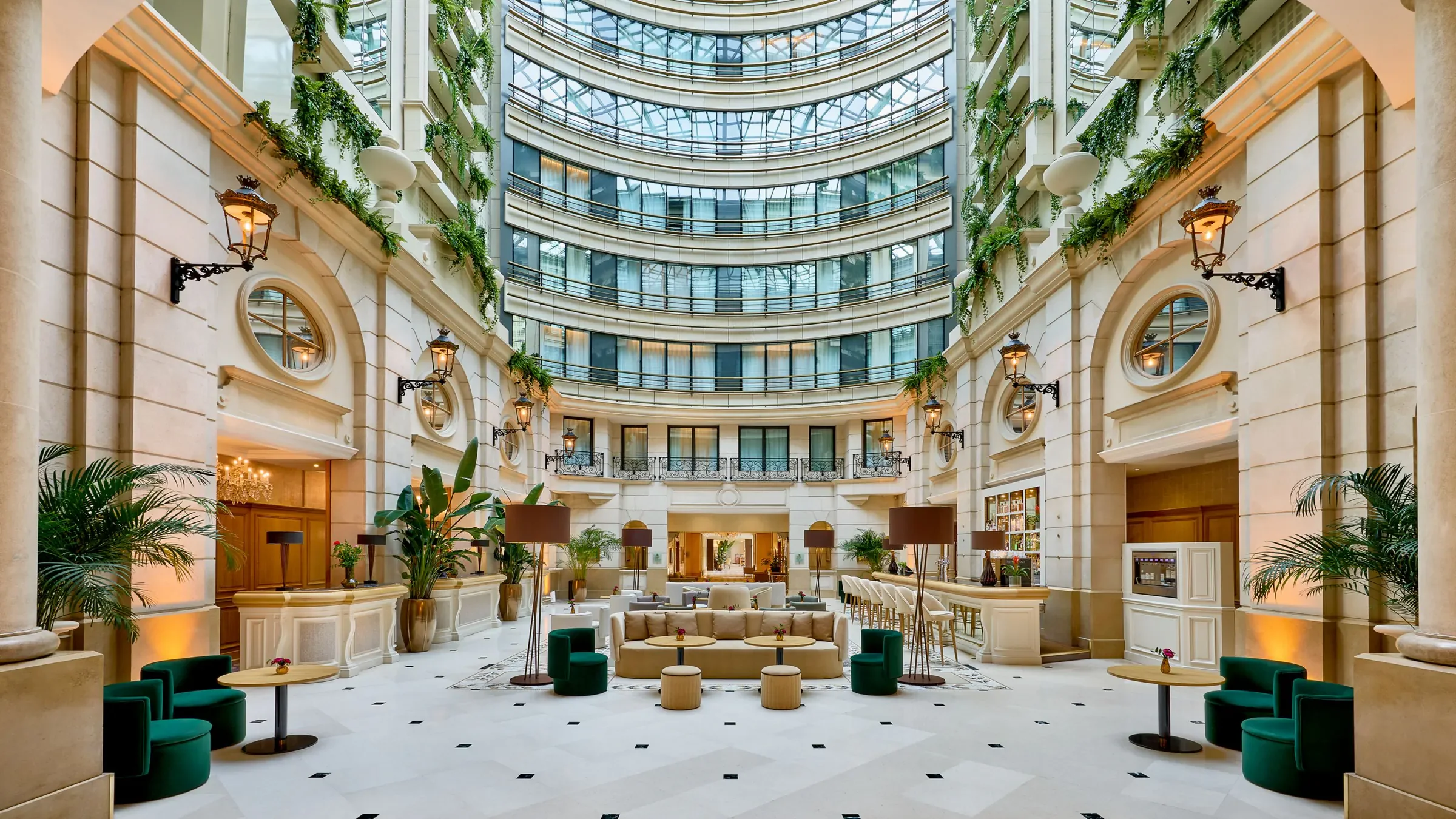
The result is a Vuitton trunk at the scale of a building. The firm made its name with hard-sided cases whose interiors could be fitted to the belongings of a particular traveller, and number 70 follows the same logic: a historic outer case, and an entirely different world packed behind it. There are 192 rooms and suites around a glass-domed atrium, with ballrooms and meeting rooms fitted into the arrangement. It is a large hotel, and its scale is as much part of its character as the stonework.
The renovation completed in 2026 has brought the building's first occupants back, if only as references. London studio Muza Lab borrowed from dressmaking and leatherwork: headboards that recall the luggage trade, lamps with the silhouette of a corset, artworks inspired by crochet. The restaurant and bar is now called Jenny, after the couturière who once worked upstairs. For years the façade told most of the Vuitton story. Now the inside has started answering.
The reason to sleep here, though, is not the decoration but the pavement outside. The hotel stands on the Champs-Élysées itself, not on a quieter side street, and is the only five-star hotel directly on the avenue. From a room facing the street, the car lights and the long sweep down towards the Concorde are part of the stay. On 14 July 2026, the national parade followed this same stretch. Rooms facing the atrium are more inward-looking; they cannot offer the boulevard. Here the room category matters more than the postal address.
A trunk is made for travelling, not for making a home, and this one has the temperament of a large international hotel: polished, busy and built for arrivals. Its windows can frame one of the grandest commercial stages in Paris, but the crowds and traffic are still waiting at the door. The neighbourhood cafés and small houses with a proprietor at the desk are a few streets away, not here.
Arnault ruled out a Vuitton hotel further up the avenue. At number 70 its old trunk has been carrying travellers for almost thirty years, and at last somebody has remembered whose it was.
Listed in 1992
The protection covers the avenue front and its roof, and nothing behind them.
One face of a deep building
From the pavement, number 70 reads as a single 1914 building, the stone front Georges Vuitton commissioned from Louis Bigaux and Koller. It is in fact the shallowest layer of the hotel. The listing covers this front and the roof above it; everything behind belongs to the rebuilding of 1996–97, which pushed the hotel across a plot of almost two thousand square metres to a second street frontage on rue de Ponthieu. What the avenue sees is the front of the plot, not its depth.
A courtyard with a lid
The atrium is where the 1997 hotel keeps its daylight: a glass cupola over the internal courtyard, reached through wrought-iron gates and a marble staircase. For a guest it works as the hotel's real street, the place where arrivals, meetings and drinks cross. The dome is also sold as a view. The Grand Atrium Suite, the hotel's largest footprint, with two bedrooms and a living room, overlooks the cupola rather than the avenue, trading the boulevard for the building's own centre.
A window in the old front
The Champs-Élysées View Room is the category the hotel sells explicitly on the avenue. Since the only listed wall on that side is the 1914 front, an avenue-facing room is the one kind of room whose window is set into Vuitton's stone. The hotel describes these rooms as having high ceilings, large windows and decorative balconies, so the 2026 interior meets the 1914 ironwork at the glass. The view is the avenue's working life at close range rather than a monument; the landmark panoramas are kept for the suites higher up.
Dinner on the courtyard floor
Jenny occupies the floor of the atrium, under the dome, so the hotel's main restaurant and bar is in effect an indoor courtyard rather than a room on the street. That shapes the experience: tables look up into glass and inwards at the hotel, not out at the traffic. The name honours Jenny Sacerdote, whose workrooms filled the upper floors from 1914. The tea service that pays her homage, with pastries by Valentin Langlais, is entirely vegetarian.
At a glance
Where
70 avenue des Champs-Élysées, 8th arrondissement, running back to rue de Ponthieu; Franklin D. Roosevelt metro nearby; Charles de Gaulle 25.2 km, Orly 22.0 km
The building
Built for Georges Vuitton by Louis Bigaux and Koller, opened May 1914, with the couturière Jenny Sacerdote upstairs; avenue façade and roof listed in 1992; rebuilt behind the façade in 1996–97 by Delaage-Tsaropoulos; hotel opened in 1997
The renovation
Full-property redesign by London studio Muza Lab, completed in 2026, drawing on dressmaking and leatherwork
Rooms
192 rooms and suites, 58 of them suites: Comfort, Superior, Terrace Room (private balcony towards Montmartre), Champs-Élysées View Room, Friends & Family; Ambassador Suite 65 m², Grand Family Suite 105 m², Grand Atrium Suite, Champs-Élysées Signature Suite (seventh floor), Eiffel Tower Presidential Suite (sixth floor)
Eating and drinking
Jenny, bar and restaurant under the glass dome with a tea service; brunch led by chef Vincent Abi Rached with pastry by Valentin Langlais; Cira, a seasonal terrace in the internal courtyard
Wellness and events
Fitness centre and sauna, no spa or pool; seven meeting venues for up to 250 guests, including the ballroom La Seine
Why this one
01
The avenue at the door.
Number 70, on the Champs-Élysées itself.
02
A trunk with a past.
The 1914 Vuitton front, listed and kept.
03
Room under the dome.
Jenny fills the glass-roofed atrium.
The Edit Notes
What a booking site will not tell you.
01
The old roof is a room.
The 1992 protection order covers two things on the avenue side: the stone front and the roof above it. The Champs-Élysées Signature Suite sits on the seventh floor, the top of the seven-storey building, with sloping ceilings and two Juliet balconies looking towards the Eiffel Tower, the Arc de Triomphe and the avenue. For a night inside what remains of 1914, the top floor on the street side comes closer than any room behind it.
02
Space faces the courtyard.
Nearly a third of the 192 keys are suites, yet the two with published floor areas, the 65 m² Ambassador Suite and the 105 m² Grand Family Suite, both have living rooms on the courtyard side. The avenue is sold through other names: the Signature Suite, the Eiffel Tower Presidential Suite on the sixth floor, the Champs-Élysées View Room. At this address, square metres and the boulevard are usually separate purchases, and families get the former.
03
The open air looks away.
For a hotel defined by its frontage, almost none of its outdoor life faces the street. Cira, the Mediterranean terrace, occupies the internal courtyard and closes in the cold months. Brunch moves into that same courtyard when the weather allows. The Terrace Room's private balcony looks north over rooftops towards Montmartre. The building offers the avenue through glass; to sit outside, it turns its back on it.
04
The ground floor went to retail.
The 1996 rebuilding did not hand the whole listed front to the hotel. The official heritage record notes that the ground floor became a large perfume shop, and an architectural survey of the site describes an extensive commercial ground floor. The street-level windows of the old Vuitton building therefore sell goods again, as they did in 1914, while the hotel lives above and behind. The trunk still has a shop in its lid.
The price question
The money here buys an address on the avenue itself, a renovation finished in 2026 and a large hotel's full apparatus: concierges, room service around the clock, meeting rooms, a restaurant under glass. It does not buy a spa, a pool or, by default, the view the address suggests. The Champs-Élysées is a category to be booked, not a given. Pay for an avenue-facing category or a suite and the premium makes sense; take the cheapest room and it is mainly a postcode.
What the money buys
A door directly on the Champs-Élysées, behind a listed 1914 front.
Rooms and public spaces redesigned throughout by Muza Lab.
Suites with named views of the avenue, the Eiffel Tower or the atrium.
What it leaves out
A spa or a swimming pool; wellness is a fitness centre and sauna.
An avenue view in every room category.
Outdoor space facing the street; the terrace is in the courtyard.
Who it suits
Book it for a stay organised around the avenue itself, in a Champs-Élysées View Room or a street-side suite, or for a family that needs the 105 m² Grand Family Suite. Look elsewhere for a spa, a pool or a small house with a proprietor's hand.
Who should spend elsewhere
Hôtel Barrière Le Fouquet's
At 46 avenue George V on the corner of the Champs-Élysées: 101 rooms and suites, a 15-metre pool and the brasserie opened in 1899.
Hôtel Plaza Athénée
On avenue Montaigne, between the Champs-Élysées and the Seine: a Dorchester Collection hotel with suites over its garden courtyard.
The Extra Edit
Confirmed with your quote
YOUR EXTRA
Something extra, from us.
Ask for a stay and a person takes it from there. Any hotel privileges that apply, and a personal Extra arranged by us, are confirmed with your bookable quote.
SipDrinks
SavourCulinary
DiscoverExperience
Tell us which Extra appeals in your request. Nothing is charged when you ask, and no upgrade is promised.
The Edit score is the editor's grade for the level of the hotel, out of ten. It weighs what the outside judges say (Michelin Keys, Forbes Travel Guide, World's 50 Best Hotels, Atout France palace status, La Liste), what changed in the last two years and what guests write now; where these and the editor's own judgement disagree, the editor decides. A spa with a pool worth booking for adds up to two tenths.
Why book through The Edit
Our personal Extra
A drink, a meal or an experience: chosen by you, arranged by us.